


.png)

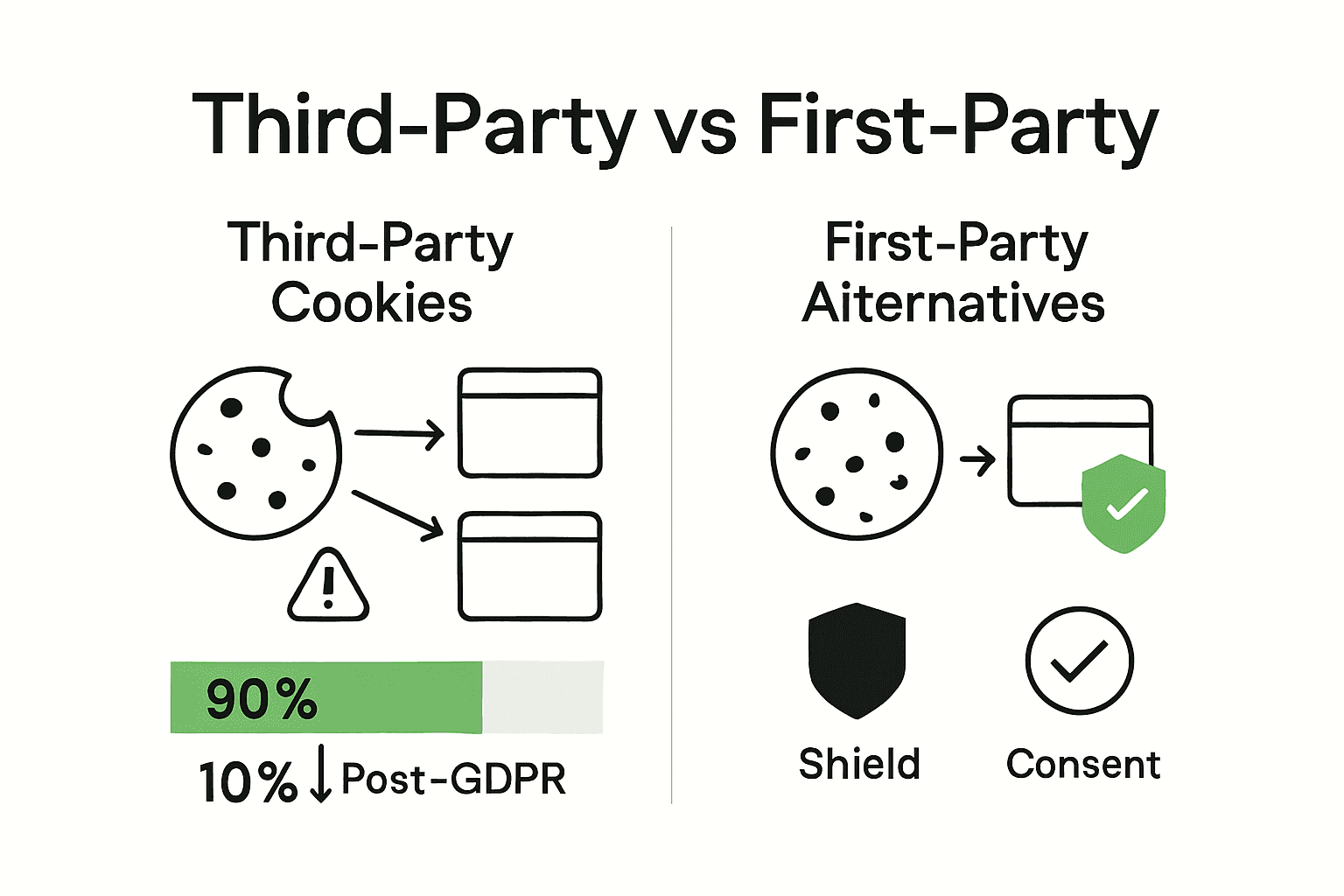
Almost 90% of top websites share user data with external partners, leaving british consumers exposed to sophisticated online tracking. Third-party cookies lie at the centre of this debate, shaping how much personal information is harvested each time you browse. Understanding these tracking methods is vital as privacy regulations and marketing strategies rapidly evolve. This guide brings clarity by unpacking how digital tracking really works, what it means for british users, and the risks and alternatives shaping the future of online privacy.
Table of Contents
- Defining 3rd Party Cookies and Key Concepts
- How 3rd Party Cookies Track Users Online
- Privacy Regulations Governing Third-Party Cookies
- Impact on Conversion Tracking and Analytics
- Risks, Data Loss, and Compliance Strategies
- Alternatives to 3rd Party Cookies for Marketers
Key Takeaways
| Point | Details |
|---|---|
| Third-party cookies facilitate extensive tracking | These cookies enable external domains to monitor user behaviour across multiple websites, raising significant privacy concerns. |
| Regulatory changes are reshaping tracking practices | Legislation like GDPR is impacting how organisations collect user data, reducing third-party cookie usage significantly. |
| Shift towards first-party data collection is essential | With the decline of third-party cookies, marketers must adapt by leveraging first-party data and alternative tracking methods. |
| Robust compliance strategies are crucial | Organisations need to establish strong data management frameworks to protect user privacy and mitigate risks associated with third-party tracking. |
Defining 3rd Party Cookies and Key Concepts
Third-party cookies represent a sophisticated tracking mechanism used by external domains to monitor user behaviour across different websites. TechTarget explains that these cookies are created by domains separate from the one a user is currently visiting, enabling comprehensive digital tracking and profiling.
At their core, third-party cookies function as small text files placed on a user’s device by websites other than the primary site being accessed. These tracking snippets allow data brokerage firms and online advertisers to collect intricate details about user preferences, browsing patterns, and potential consumer behaviours. Pages Research highlights that these cookies can accumulate extensive user information, raising significant privacy concerns across digital ecosystems.
The technical mechanism of third-party cookies involves embedding tracking scripts from external domains into websites. When a user visits a page containing these scripts, the third-party domain can instantly set a cookie, enabling cross-site tracking and data aggregation. This process allows advertisers and analytics platforms to:

- Build comprehensive user profiles
- Track user movements across multiple websites
- Deliver targeted advertising
- Analyse user behaviour patterns
For marketers and digital professionals seeking deeper insights into web tracking dynamics, our guide on web tracking insights offers a comprehensive exploration of these sophisticated digital surveillance techniques.
How 3rd Party Cookies Track Users Online
User tracking through third-party cookies represents a complex digital surveillance mechanism that enables comprehensive online behaviour monitoring. arXiv Research reveals a startling statistic: nearly 90% of popular websites leak user data to external parties, with over 60% spawning third-party cookies that track users across multiple digital platforms.
The tracking process involves sophisticated digital fingerprinting techniques where third-party domains embed tracking scripts into websites. When users browse different sites, these scripts silently collect extensive data points including browsing history, interaction patterns, device information, and demographic insights. arXiv Research highlights how persistent browser identification through these cookies allows trackers to collapse online contexts, effectively identifying users across distinct web environments and fundamentally compromising personal privacy.
Third-party cookie tracking mechanisms operate through several intricate methods:
- Embedding invisible tracking pixels
- Recording user interactions and page visits
- Collecting browser and device metadata
- Constructing comprehensive user profiles
- Synchronising data across multiple advertising networks
For digital professionals seeking deeper understanding of these tracking dynamics, our guide on tracking user behaviour provides comprehensive insights into modern web surveillance techniques.
Privacy Regulations Governing Third-Party Cookies
The landscape of digital privacy regulations has undergone significant transformation in recent years, with legislative frameworks like the General Data Protection Regulation (GDPR) fundamentally reshaping how organisations collect and manage user data. NetSys Research reveals that GDPR’s implementation has already produced measurable impacts, demonstrating a notable 10% reduction in third-party cookie deployment across digital platforms.
Regulatory complexities surrounding third-party cookies have created substantial challenges for digital businesses and online platforms. EurekAlert Research exposes a startling finding: up to 90% of governmental websites in certain jurisdictions continue to set tracking cookies without explicit user consent, even in regions with stringent privacy legislation. This persistent non-compliance underscores the ongoing tension between technological tracking capabilities and user privacy protection.
Key privacy regulations impacting third-party cookie usage include:
- European Union’s General Data Protection Regulation (GDPR)
- California Consumer Privacy Act (CCPA)
- United Kingdom’s Data Protection Act
- ePrivacy Directive
- Brazil’s General Data Protection Law (LGPD)
For digital professionals seeking comprehensive insights into navigating these complex regulatory landscapes, our guide on understanding GDPR’s impact on analytics provides essential strategic guidance for modern digital compliance.
Impact on Conversion Tracking and Analytics
The decline of third-party cookies has triggered a fundamental transformation in digital marketing analytics and conversion tracking methodologies. arXiv Research highlights that browsers are increasingly blocking third-party cookies, compelling advertisers and digital marketers to pivot towards alternative tracking strategies, particularly emphasising first-party cookie implementations to maintain data integrity and precision.
This technological shift presents significant challenges for digital marketing professionals. arXiv Research reveals that the erosion of traditional third-party cookie tracking mechanisms has necessitated a comprehensive re-evaluation of conversion tracking approaches. Organisations must now develop more sophisticated detection and mitigation strategies to ensure accurate user behaviour analysis and maintain the effectiveness of their digital marketing campaigns.
Key implications for conversion tracking include:
- Reduced cross-site tracking capabilities
- Increased reliance on first-party data collection
- Development of more privacy-conscious tracking methods
- Enhanced server-side tracking techniques
- Greater emphasis on user consent and transparency
For digital marketing professionals seeking comprehensive guidance on navigating these complex tracking challenges, our guide on monitoring conversions effectively provides essential strategic insights for modern analytics implementation.
Risks, Data Loss, and Compliance Strategies
Third-party cookies represent a significant digital security vulnerability, exposing organisations to substantial data privacy risks. TechTarget Research warns that these tracking mechanisms enable the comprehensive collection of detailed user profiles, which can be systematically exploited by malicious actors for potential identity theft, fraudulent activities, and unauthorized data commercialisation.
The evolving digital landscape demands sophisticated compliance strategies to mitigate these inherent risks. arXiv Research highlights that transitioning to first-party cookie tracking introduces nuanced privacy challenges, compelling organisations to develop robust frameworks that meticulously balance data collection requirements with stringent user privacy protections. This necessitates a proactive approach to data management and consent mechanisms.
Key risk mitigation and compliance strategies include:
- Implementing comprehensive user consent protocols
- Conducting regular privacy impact assessments
- Developing transparent data collection policies
- Encrypting and anonymising collected user data
- Establishing clear data retention and deletion procedures
- Training staff on privacy compliance requirements
For digital professionals seeking comprehensive guidance on navigating these complex compliance landscapes, our guide on data compliance in marketing provides essential strategic insights for modern data protection approaches.
Alternatives to 3rd Party Cookies for Marketers
Marketers are rapidly exploring innovative tracking alternatives to navigate the evolving digital privacy landscape. Wikipedia introduces Federated Learning of Cohorts (FLoC), a sophisticated approach that groups users into cohorts based on similar browsing behaviours, enabling interest-based advertising while maintaining individual privacy protections.
Beyond traditional tracking methods, advanced techniques are emerging to address digital identification challenges. Wikipedia highlights canvas fingerprinting as a cutting-edge technique that allows websites to generate unique user identifiers by exploiting HTML5 canvas element characteristics, effectively tracking users without relying on conventional cookie mechanisms.
Key alternative tracking strategies include:
- Federated Learning of Cohorts (FLoC)
- Canvas fingerprinting
- First-party data collection
- Server-side tracking
- Contextual advertising
- Consent management platforms
- Probabilistic identification techniques
For digital marketing professionals seeking comprehensive guidance on navigating these emerging tracking technologies, our guide on data privacy in digital marketing provides essential strategic insights for modern marketing approaches.
Overcome Tracking Challenges with Next-Level Conversion Solutions
The shift away from third-party cookies presents major hurdles in accurate conversion tracking and data compliance. If you are concerned about losing valuable insights due to restricted cross-site tracking or struggling with complex consent requirements, you are not alone. Server-side tagging and robust consent management are now crucial to maintain precise analytics while respecting privacy regulations like GDPR.

Transform your tracking strategy today by adopting AdPage’s cutting-edge platform. Our tools empower marketing agencies and e-commerce businesses to capture 100% of conversions without depending on outdated third-party cookies. Benefit from seamless integrations with Shopify, WooCommerce, and Magento, plus expert onboarding and compliance support. Don’t let privacy changes derail your campaign effectiveness. Act now to secure reliable data collection and maximise your marketing impact with AdPage. To deepen your knowledge and enhance your results, explore our in-depth guide on monitoring conversions effectively.
Frequently Asked Questions
What are third-party cookies?
Third-party cookies are small text files created by external domains, not the website you are currently visiting. They track user behaviour across multiple sites, allowing advertisers and data brokers to collect information about user preferences and browsing habits.
How do third-party cookies track users online?
Third-party cookies track users through embedded scripts and pixels on websites, collecting data on browsing history, interactions, and device information to build comprehensive user profiles and facilitate targeted advertising.
What are the privacy regulations affecting third-party cookies?
Key privacy regulations include the General Data Protection Regulation (GDPR), California Consumer Privacy Act (CCPA), and the ePrivacy Directive. These laws aim to protect user privacy and require organisations to be transparent about their data collection practices.
What are the alternatives to third-party cookies for marketers?
Marketers can explore alternatives such as Federated Learning of Cohorts (FLoC), canvas fingerprinting, first-party data collection, server-side tracking, and contextual advertising to adapt to the evolving digital privacy landscape.