


.png)

Most online journeys are tracked from start to finish, often without users even realising it. For british consumers and businesses, understanding how ad trackers operate is more important than ever as these tools quietly shape digital marketing and personal privacy. With over 89 percent of cookie banners found in violation of legal standards, knowing how tracking mechanisms work empowers you to stay informed, make better choices, and safeguard your interests in an increasingly connected world.
Table of Contents
- What Are Ad Trackers And How They Work
- Major Types Of Ad Trackers In E-Commerce
- Core Features And Data Collection Methods
- Legal Compliance And Consent Management
- Risks, Benefits, And Best Practice Recommendations
Key Takeaways
| Point | Details |
|---|---|
| Understanding Ad Trackers | Ad trackers are digital tools that monitor user interactions and help businesses analyse advertising effectiveness. |
| Types of Ad Trackers | E-commerce primarily utilises pixel trackers, cookie trackers, session trackers, and cross-site trackers for comprehensive data collection. |
| Legal Compliance | Businesses must navigate complex legal requirements, obtaining explicit user consent and ensuring transparency in data practices. |
| Risks and Benefits | Responsible ad tracking must balance privacy protection and data collection, utilising ethical practices to maintain user trust. |
What Are Ad Trackers and How They Work
Ad trackers are sophisticated digital monitoring tools designed to collect and analyse user interactions across websites and digital platforms. According to Wikipedia, ad tracking is a form of in-market research that monitors a brand’s performance, tracking crucial metrics like advertising awareness, product usage, and competitive positioning.
At their core, ad trackers function through small pieces of code embedded in web pages and digital advertisements. These tracking mechanisms, often called web beacons, allow businesses to unobtrusively monitor user activities and engagement patterns. Wikipedia explains that web beacons are typically deployed by third parties to conduct web analytics and track page interactions with minimal user interference.
The operational mechanics of ad trackers involve several key processes:
- Data Collection: Gathering user interaction data like clicks, page views, and time spent
- User Segmentation: Categorising users based on browsing behaviour and demographic information
- Performance Tracking: Measuring advertisement effectiveness and conversion rates
- Behavioural Analysis: Understanding user preferences and potential purchase intentions
By leveraging these insights, marketers can create more targeted and personalised advertising strategies. Learn more in our web tracking insights guide to understand how modern digital marketing harnesses these sophisticated tracking technologies.
Major Types of Ad Trackers in E-Commerce
E-commerce businesses leverage multiple sophisticated ad tracking technologies to understand and optimise user interactions. Wikipedia describes these technologies, particularly web beacons (tracking pixels), as small, often invisible images embedded in web pages that enable comprehensive monitoring of user behaviour and data collection for targeted advertising.
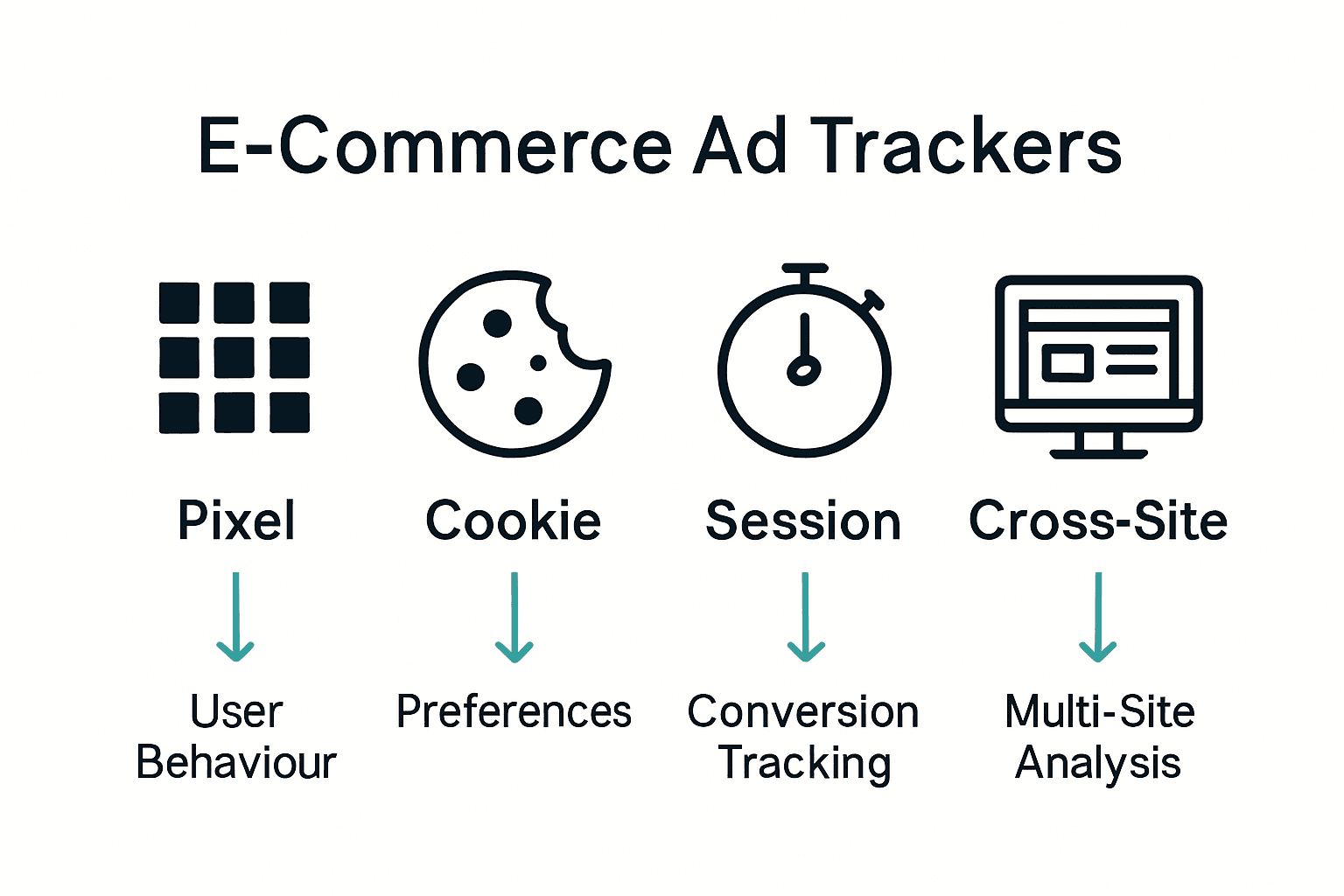
The primary types of ad trackers used in e-commerce include:
- Pixel Trackers: Tiny, transparent images that record user interactions and page views
- Cookie Trackers: Small text files stored on user devices to track browsing history and preferences
- Session Trackers: Monitor user activities within a single website visit
- Cross-Site Trackers: Follow user behaviour across multiple websites and platforms
According to Wikipedia, these tracking methods help businesses assess advertisement performance by collecting critical data on user interactions. By understanding different tracking mechanisms, marketers can create more targeted and effective digital strategies.

To dive deeper into implementing robust tracking systems that drive e-commerce success, check out our guide on setting up efficient tracking strategies for the latest insights and best practices.
Core Features and Data Collection Methods
Ad tracker data collection represents a sophisticated approach to understanding digital user interactions. Wikipedia explains that web beacons function by embedding small, often invisible images in web pages, which send detailed server requests capturing critical user data such as IP addresses, access times, and device specifications.
The core features of ad tracking technologies encompass several key data collection methods:
- User Identification: Capturing unique user identifiers across different platforms
- Behavioural Tracking: Monitoring user interactions, clicks, and navigation patterns
- Conversion Monitoring: Tracking specific user actions like purchases or sign-ups
- Demographic Segmentation: Collecting anonymised user profile information
According to Wikipedia, these tracking mechanisms are essential for assessing advertisement effectiveness by collecting critical metrics like click-through rates, conversion rates, and overall user engagement. Marketers use these insights to refine targeting strategies and improve campaign performance.
To gain deeper insights into interpreting and leveraging user data effectively, explore our guide on understanding user data collection for comprehensive strategies in e-commerce analytics.
Legal Compliance and Consent Management
E-commerce businesses face increasingly complex legal challenges surrounding user data tracking and consent management. A groundbreaking study from arXiv reveals a startling statistic: approximately 89% of analysed cookie banners violated applicable legal requirements, highlighting the significant compliance challenges in digital tracking practices.
Key considerations for legal compliance in ad tracking include:
- Explicit User Consent: Obtaining clear, informed permission before data collection
- Transparent Data Practices: Clearly communicating what data is collected and how it will be used
- User Control Mechanisms: Providing easy opt-out and data deletion options
- Regulatory Alignment: Adhering to frameworks like GDPR, CCPA, and other regional regulations
Research from arXiv further underscores the complexity of compliance, demonstrating that user data is frequently collected and shared even when individuals attempt to opt out. This reveals significant gaps between regulatory intentions and actual implementation.
To navigate these intricate legal landscapes effectively, businesses should explore our comprehensive guide on consent management, which provides strategic insights for maintaining robust, legally compliant tracking practices.
Risks, Benefits, and Best Practice Recommendations
Navigating the complex landscape of ad tracking requires a nuanced understanding of both potential risks and strategic benefits. arXiv highlights critical privacy concerns, particularly around cookie syncing, which can compromise user data transparency and undermine trust in digital ecosystems.
Key considerations for responsible ad tracking include:
- Privacy Protection: Implementing robust data security measures
- Transparent Consent: Developing clear, user-friendly consent mechanisms
- Data Minimisation: Collecting only essential information
- User Control: Providing straightforward opt-out and data management options
Research from arXiv reveals the prevalence of manipulative dark patterns in consent interfaces, demonstrating how seemingly innocent design choices can significantly influence user choices and undermine genuine consent. These findings underscore the importance of ethical tracking practices that prioritize user autonomy.
For businesses seeking to balance data insights with user privacy, our guide on understanding user data privacy offers comprehensive strategies to navigate these complex digital compliance challenges.
Unlock the Full Potential of Ad Tracking for Your E-Commerce Business
Understanding ad trackers is crucial for overcoming common challenges such as data loss, fragmented user insights, and compliance risks highlighted in the article. If you want to maximise your e-commerce insights by accurately capturing every conversion and respecting user consent, you need a solution that goes beyond traditional tracking methods. Key concepts like server-side tagging and consent management are essential tools to regain control of your data and build trust with your customers.
Take control with AdPage, a platform specifically built to tackle these challenges. Our advanced server-side tagging ensures 100% conversion tracking so you never miss vital user activities. We also prioritise GDPR-compliant consent management, helping you navigate complex legal requirements with confidence. Whether you use Shopify, WooCommerce, or Magento, our seamless integration and expert onboarding make optimising your ad tracking straightforward and effective.
Take the next step to transform your tracking capabilities and boost your marketing performance now.

Discover how to capture every conversion accurately and maintain airtight compliance with AdPage’s powerful tracking platform. Visit us today and start improving your e-commerce insights immediately.
Frequently Asked Questions
What is an ad tracker and how does it work?
Ad trackers are digital monitoring tools that collect and analyse user interactions on websites and digital platforms. They function through small pieces of code embedded in web pages and ads, allowing businesses to monitor activities and engagement patterns.
What are the different types of ad trackers used in e-commerce?
The primary types of ad trackers in e-commerce include pixel trackers, cookie trackers, session trackers, and cross-site trackers. Each serves a unique purpose in monitoring user behaviour and optimising advertising strategies.
How do ad trackers collect user data?
Ad trackers use various methods to collect data, including user identification, behavioural tracking, conversion monitoring, and demographic segmentation. These methods capture essential metrics that help assess advertisement effectiveness.
What are the legal considerations for using ad trackers?
E-commerce businesses must prioritise explicit user consent, transparent data practices, user control mechanisms, and compliance with regulations like GDPR and CCPA to ensure responsible ad tracking and manage legal risks.