


.png)

Most e-commerce managers face a daily flood of data, yet only about 20 percent feel confident they are using analytics effectively. In such a fast-paced market, the real challenge is not gathering information, but understanding what matters most to your business. Analytics dashboards bring crucial clarity, transforming raw numbers into meaningful insights and giving you the tools to track performance, identify trends, and make smarter decisions—often faster than the competition.
Table of Contents
- Defining Analytics Dashboards For E-Commerce
- Types Of Analytics Dashboards And Their Uses
- Core Features And Key Metrics Explained
- Integrating Server-Side Tagging Solutions
- Consent Management And Gdpr Compliance Essentials
- Avoiding Data Loss And Improving Conversion Tracking
Key Takeaways
| Point | Details |
|---|---|
| Importance of Analytics Dashboards | Analytics dashboards are crucial for e-commerce as they transform complex data into actionable insights, enabling quick decision-making. |
| Types of Dashboards | E-commerce dashboards come in three types: strategic for long-term planning, operational for real-time monitoring, and analytical for in-depth data analysis. |
| Server-Side Tagging Benefits | Server-side tagging enhances data accuracy and privacy by shifting tracking processes away from client-side scripts, improving website performance. |
| GDPR Compliance in Data Management | Effective consent management is essential for GDPR compliance, building customer trust through transparent data practices and clear consent mechanisms. |
Defining Analytics Dashboards for E-Commerce
In the dynamic world of e-commerce, analytics dashboards serve as critical visual navigation tools that transform complex data streams into actionable insights. According to Wikipedia), a dashboard is a graphical user interface that provides at-a-glance views of key performance indicators relevant to a particular business objective, specifically aggregating data from multiple sources to present real-time insights into sales, customer behavior, and operational performance.
These digital command centres go far beyond simple data displays. They are sophisticated visual platforms that enable e-commerce professionals to understand intricate performance metrics instantly. Imagine a mission control room where every metric, from conversion rates to customer acquisition costs, is displayed with stunning clarity and immediate context. Analytics dashboards break down complex information into digestible visual formats like graphs, charts, and heat maps, allowing marketers and business leaders to make rapid, informed decisions.
Key components of an effective e-commerce analytics dashboard typically include:
- Sales Performance Metrics: Total revenue, average order value, conversion rates
- Traffic Analysis: Website visitors, traffic sources, user engagement
To truly leverage these insights, learn how to use analytics dashboards effectively in our tutorial, which provides a comprehensive guide to transforming raw data into strategic business intelligence.
The power of analytics dashboards lies in their ability to synthesise vast quantities of information into clear, actionable narratives. By presenting data visually and contextually, they empower e-commerce professionals to understand complex business dynamics at a glance, enabling faster, more strategic decision-making that can significantly impact bottom-line performance.
Types of Analytics Dashboards and Their Uses
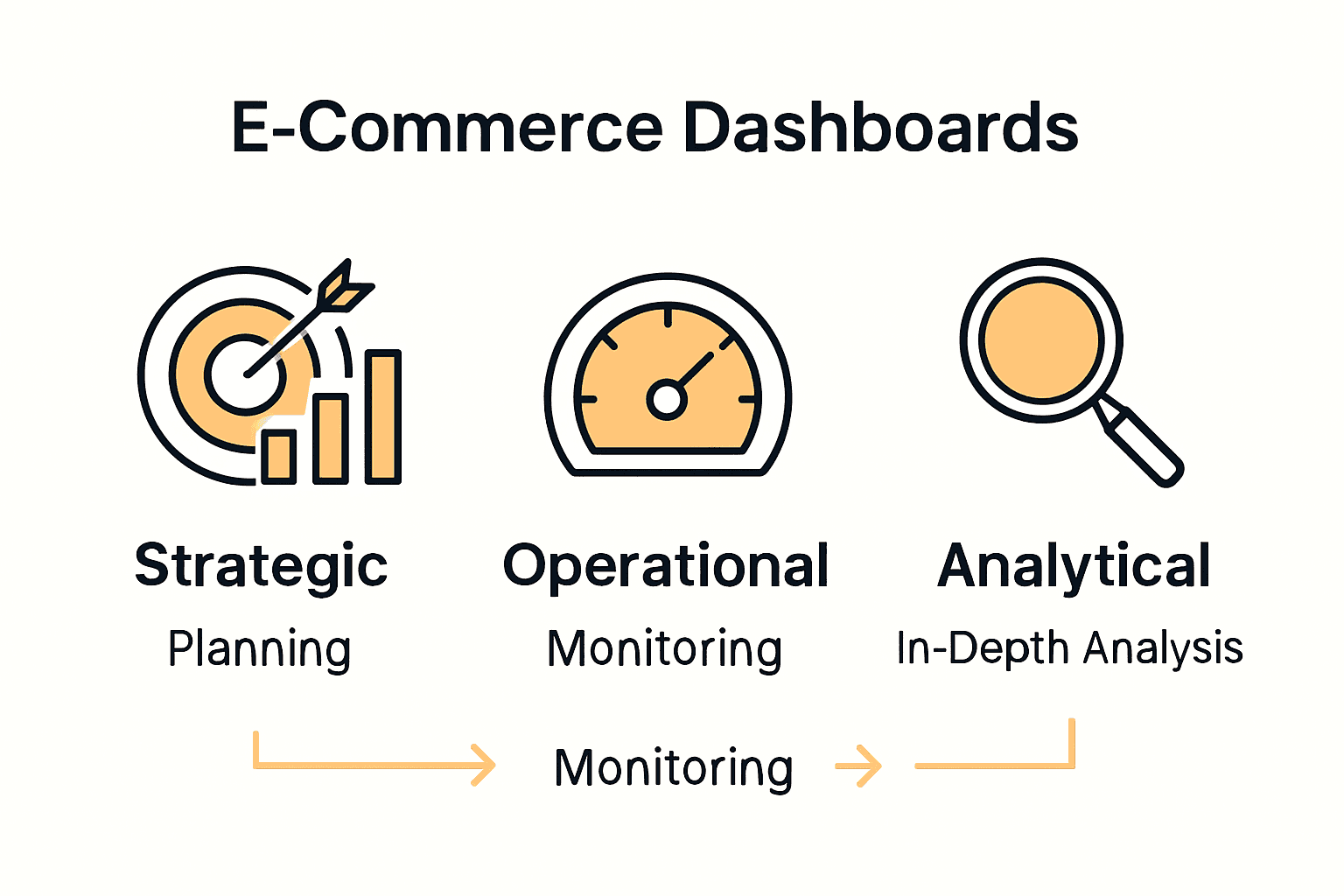
Analytics dashboards are not a one-size-fits-all solution. According to BDO, data analytics dashboards are categorically divided into three distinct types: strategic, operational, and analytical. Each serves a unique purpose in helping e-commerce businesses understand and optimize their performance.
Let’s break down these dashboard types and their specific applications. Strategic dashboards offer a high-level panoramic view of key performance indicators (KPIs), designed for long-term planning and executive decision-making. These dashboards provide senior management with an overarching perspective on business health, tracking metrics like annual revenue, market share, and growth trajectories. They are typically reviewed less frequently - perhaps monthly or quarterly - and focus on big-picture trends rather than minute details.

In contrast, operational dashboards are the real-time pulse monitors of your e-commerce ecosystem. They track immediate processes, current performance, and emerging issues that require instant attention. These dashboards are dynamic, updating in near real-time to show:
- Current website traffic
- Active user sessions
- Order processing status
- Inventory levels
- Customer support ticket volumes
To dive deeper into leveraging these analytics effectively, explore our comprehensive guide on e-commerce analytics strategies, which provides nuanced insights into transforming raw data into actionable business intelligence.
The third category, analytical dashboards, represents the most sophisticated tier of data visualization. These dashboards enable deep, granular data analysis, allowing businesses to identify complex patterns, predict trends, and make data-driven strategic decisions. By aggregating historical data and applying advanced statistical models, analytical dashboards help e-commerce professionals uncover hidden insights, understand customer behavior nuances, and forecast future performance with remarkable precision.
Core Features and Key Metrics Explained
E-commerce analytics dashboards are sophisticated tools that transform raw data into actionable business intelligence. According to Feld-M, effective dashboards should include core features such as real-time data updates, customizable views, and interactive elements that empower businesses to make informed decisions quickly and efficiently.
Core Features of top-tier analytics dashboards typically encompass several critical capabilities. These include dynamic data visualization, which translates complex numerical information into intuitive graphs and charts. Real-time reporting ensures that businesses can monitor performance instantaneously, while user-friendly interfaces allow even non-technical team members to navigate and interpret data with ease. According to American Eagle, the most powerful dashboards offer seamless data representation that makes understanding business metrics straightforward.
Key metrics every e-commerce dashboard should track include:
- Conversion Rates: Percentage of visitors who complete a purchase
- Average Order Value: Total revenue divided by number of orders
- Customer Acquisition Cost: Total marketing expenses divided by new customers acquired
- Customer Lifetime Value: Predicted total revenue from a customer relationship
Discover more about critical e-commerce metrics in our comprehensive guide on understanding analytics, which provides deeper insights into interpreting and leveraging these crucial performance indicators.
Beyond mere number tracking, modern analytics dashboards serve as strategic command centres. They not only display current performance but also help predict future trends, identify potential bottlenecks, and uncover opportunities for optimization. By presenting data in context and providing interactive exploration capabilities, these dashboards transform raw numbers into a narrative that guides strategic decision-making across marketing, sales, and operational teams.
Integrating Server-Side Tagging Solutions
Server-side tagging represents a transformative approach to data collection and management for e-commerce platforms. According to arXiv research, this innovative method involves processing and managing tags on the server rather than the client, which significantly enhances data accuracy and security while improving overall user experience.
The core advantage of server-side tagging lies in its ability to fundamentally reshape how digital businesses handle data tracking. Traditional client-side tracking relies on browser-based scripts, which can be blocked by ad blockers, privacy tools, and slow down website performance. In contrast, server-side tagging moves critical data processing behind the scenes, creating a more robust and reliable tracking mechanism. Another arXiv research publication highlights that this approach enables e-commerce platforms to handle data collection more efficiently, leading to improved data quality and enhanced compliance with privacy regulations.
Key benefits of server-side tagging include:
- Improved Performance: Reduced page load times
- Enhanced Privacy: Better data protection and regulatory compliance
- Increased Accuracy: More reliable data collection
- Reduced Tracking Interference: Minimized impact from browser extensions
Explore the comprehensive advantages of server-side tagging for marketers in our detailed guide, which provides in-depth insights into this revolutionary tracking approach.
Implementing server-side tagging requires a strategic approach. E-commerce businesses must carefully map their data flow, choose appropriate server-side tag management platforms, and ensure seamless integration with existing analytics infrastructure. By shifting data processing from client to server, companies can create more resilient, accurate, and privacy-compliant tracking systems that provide deeper insights while maintaining optimal website performance.
Consent Management and GDPR Compliance Essentials
Consent management has become a critical cornerstone of responsible digital marketing in the e-commerce landscape. According to arXiv research, implementing robust consent management systems is crucial for businesses to comply with GDPR regulations, ensuring that user data is collected and processed lawfully while maintaining transparency and building customer trust.
The fundamental principle of GDPR compliance revolves around obtaining explicit user consent before collecting or processing personal data. Another arXiv publication emphasizes that e-commerce platforms must provide clear communication about data usage and offer users comprehensive options to manage their personal information preferences. This means going beyond simple checkbox agreements and creating genuinely transparent data handling processes that empower users to understand and control their digital footprint.
Key elements of effective consent management include:
- Clear Language: Explaining data usage in simple, understandable terms
- Granular Consent: Allowing users to select specific data processing permissions
- Easy Withdrawal: Simple mechanisms to revoke consent at any time
- Comprehensive Tracking: Maintaining detailed records of user consent
Discover the nuanced details of consent management in our comprehensive guide, which provides in-depth insights into navigating the complex landscape of user data protection.
Successful GDPR compliance is not just about avoiding penalties but about establishing a trust-based relationship with customers. E-commerce businesses must view consent management as a strategic opportunity to demonstrate respect for user privacy, differentiate themselves in a crowded market, and build long-term customer loyalty through transparent and ethical data practices.
Avoiding Data Loss and Improving Conversion Tracking
Conversion tracking is the lifeblood of e-commerce analytics, providing crucial insights into customer behavior and marketing performance. According to arXiv research, preventing data loss requires implementing robust data collection frameworks and consistently auditing analytics setups to ensure maximum accuracy and reliability.
E-commerce businesses face significant challenges in maintaining comprehensive tracking across multiple platforms and user interactions. Traditional client-side tracking methods are inherently vulnerable to data gaps caused by ad blockers, slow internet connections, and browser limitations. Another arXiv publication emphasizes that advanced analytics tools can provide real-time insights into user behavior and conversion paths, helping businesses overcome these tracking obstacles.
Key strategies for improving conversion tracking include:
- Server-Side Tagging: Move tracking logic to server infrastructure
- Multi-Channel Attribution: Track conversions across different marketing channels
- Real-Time Monitoring: Implement continuous data collection mechanisms
- Redundant Tracking: Create backup tracking methods
Learn about the most common tracking mistakes to avoid in our comprehensive guide, which offers practical insights into maintaining data integrity.
Successful conversion tracking is not just about collecting data, but about creating a holistic understanding of customer journeys. By implementing sophisticated tracking strategies, e-commerce businesses can transform raw data into actionable intelligence, enabling more targeted marketing efforts, improved user experiences, and ultimately, higher conversion rates.
Maximise Your E-Commerce Success with Precise Analytics and Conversion Tracking
Understanding analytics dashboards is only the first step towards real growth in e-commerce. The article highlights challenges around data loss, complex tracking, and GDPR compliance that can cloud decision-making and stall performance. If you are managing multiple data sources or struggling with unreliable conversion tracking, the frustration of missed insights and obscure customer journeys is real. You need a solution that brings clarity, accuracy, and compliance together with ease.
Boldly step beyond traditional limitations with AdPage. Our powerful platform specialises in server-side tagging, consent management, and real-time conversion monitoring so you never miss important data again. Designed specifically for marketing agencies and online marketers, AdPage ensures 100% reliable data collection and analysis while maintaining GDPR compliance. Seamless integration with Shopify, WooCommerce, and Magento means you can get started quickly and optimise your analytics dashboards for sharper insights and smarter decisions.
Discover how to transform your e-commerce analytics and tracking by visiting AdPage’s platform.

Take control of your e-commerce data today and experience the difference of complete, actionable insights. Begin by exploring our onboarding services and solutions to improve your conversion rates with confidence and precision.
Frequently Asked Questions
What is an analytics dashboard in e-commerce?
An analytics dashboard is a visual interface that displays key performance indicators (KPIs) relevant to e-commerce businesses, allowing users to monitor sales, customer behavior, and operational performance in real-time.
What are the different types of analytics dashboards?
There are three main types of analytics dashboards: strategic dashboards for long-term planning, operational dashboards for real-time performance monitoring, and analytical dashboards for in-depth data analysis and insights.
How can I ensure accurate conversion tracking in my e-commerce business?
To improve conversion tracking accuracy, implement server-side tagging, utilize multi-channel attribution, enable real-time monitoring, and establish backup tracking methods to maintain data integrity and prevent loss.
What core metrics should be included in an e-commerce analytics dashboard?
Core metrics to track include conversion rates, average order value, customer acquisition cost, and customer lifetime value. These metrics provide crucial insights into business performance and customer behavior.