


.png)

Choosing the right platform to capture and understand customer actions can feel like solving a puzzle with too many missing pieces. From tracking sales you never see on your dashboard to finding out which campaigns actually drive results, each option promises something different. Some focus on absolute accuracy and reliability, while others are all about ease of use or integrating with every tool you already have. Whether your priority is stronger privacy, simpler setup, or deeper insights across all your marketing efforts, the differences between these solutions are striking. Curious how they stand apart when it comes to solving the measurement challenge? Read on and discover how each one tackles the problem from a unique angle.
Table of Contents
adpage.io
At a Glance
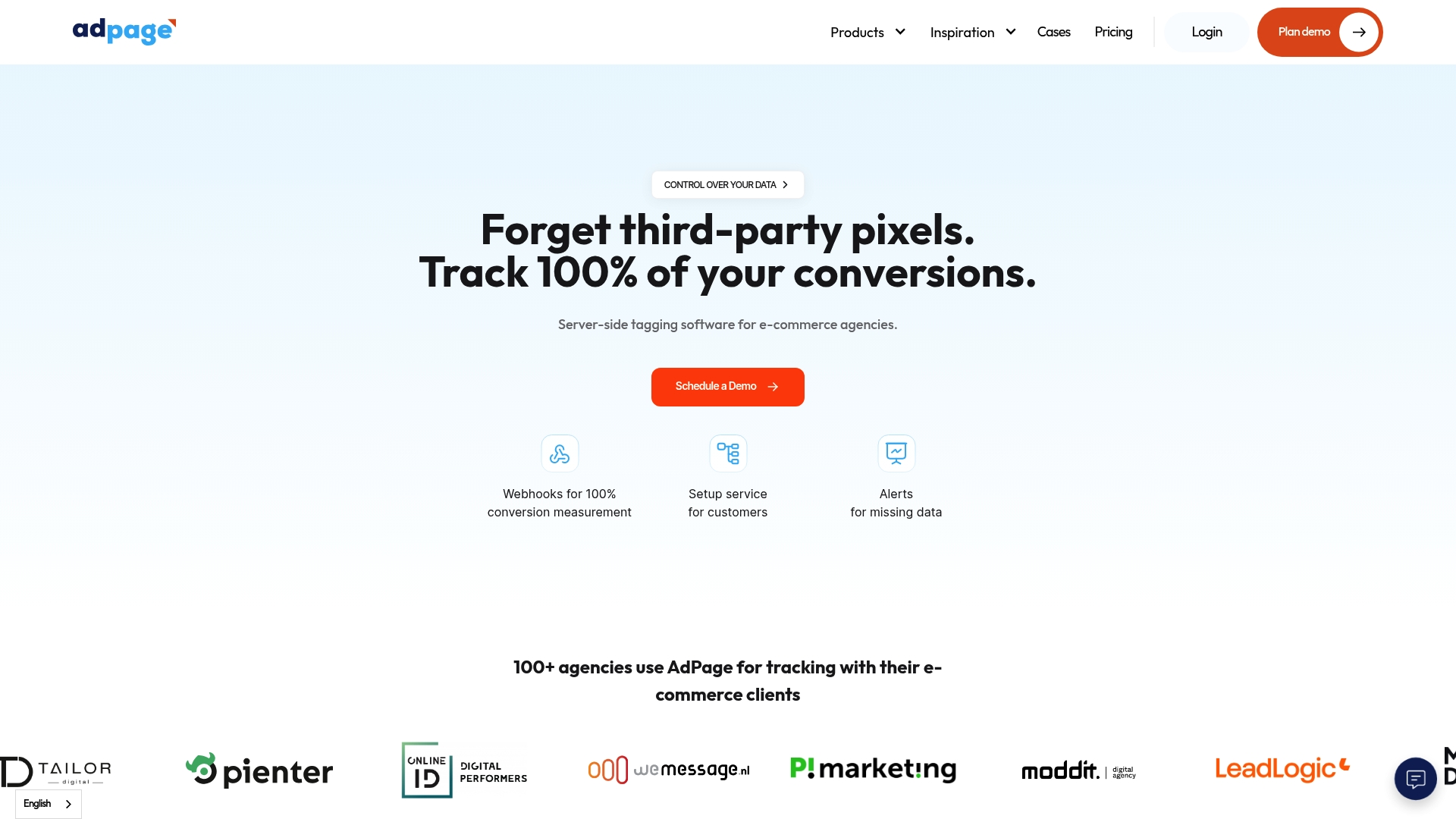
adpage.io is a focused server-side tagging platform built to eliminate conversion data loss for e-commerce businesses and marketing agencies. It combines 100% conversion-data tracking with AI-driven analysis and a done-for-you setup service, so you see reliable results quickly. If you need unequivocal measurement of campaign performance and fewer blind spots in reporting, adpage.io delivers a pragmatic, enterprise-grade solution. It’s engineered for accuracy rather than bells and whistles.
Core Features
adpage.io’s core capability is server-side tagging implementation that prevents missing data at source, supported by webhooks that capture conversions even when visitors never reach a traditional thank-you page. The platform includes a done-for-you setup service that covers technical installation and ongoing management, plus 24/7 monitoring for tracking-script changes to prevent silent data errors. Integrations are comprehensive and include Shopify, WooCommerce, Magento, WordPress, Google Tag Manager and Google Analytics. Combined with AI-driven data analyses, these features turn disparate signals into usable conversion intelligence.
Pros
- Guarantees comprehensive conversion coverage: The server-side approach and webhook architecture ensure you can measure conversions that client-side tagging often misses.
- Fast, professional onboarding: The done-for-you setup service reduces the learning curve and accelerates time-to-value for agencies and in-house teams.
- Robust platform monitoring: Continuous monitoring and alerts minimise the risk of unnoticed tracking failures undermining campaign insights.
- Broad e-commerce and analytics compatibility: Native integrations with major e-commerce platforms and analytics tools simplify implementation and preserve existing workflows.
- Data-driven decision support: AI-driven analyses help you spot anomalies and trends faster, improving optimisation of media spend and creative tests.
Who It’s For
adpage.io is designed for marketing professionals, e-commerce managers, agencies and freelancers who require full confidence in their conversion data. If you manage multiple client stores, run complex ad funnels or rely on aggregated conversion signals for bidding decisions, this platform eliminates common tracking blind spots and reduces manual reconciliation. You should expect some technical coordination up front or choose the installation service for a turnkey launch.
Unique Value Proposition
What sets adpage.io apart is the combination of 100% conversion-data ambition with a pragmatic delivery model: server-side tracking plus webhooks, backed by a done-for-you service and continuous monitoring. Where many solutions ask you to rewire your stack alone, adpage.io provides technical execution as part of the offering, so agencies and brands get production-grade data sooner. The AI-driven analyses accelerate insight extraction from that complete dataset, meaning optimisation decisions are based on fuller, cleaner signals. Trade-offs are deliberate: the platform prioritises measurement fidelity and operational reliability over cosmetic features, and that focus makes it a superior choice if accurate attribution and campaign optimisation are your primary objectives.
Real World Use Case
A marketing agency implements adpage.io for multiple clients to consolidate conversions across differing checkout flows. Using server-side tags and webhooks, the agency captures purchases and lead events that previously slipped past client-side pixels, allowing them to refine bidding strategies and improve reported ROAS.
Pricing
Pricing is not specified on the website and appears to be offered on request or according to service package.
Website: https://adpage.io
Stape
At a Glance
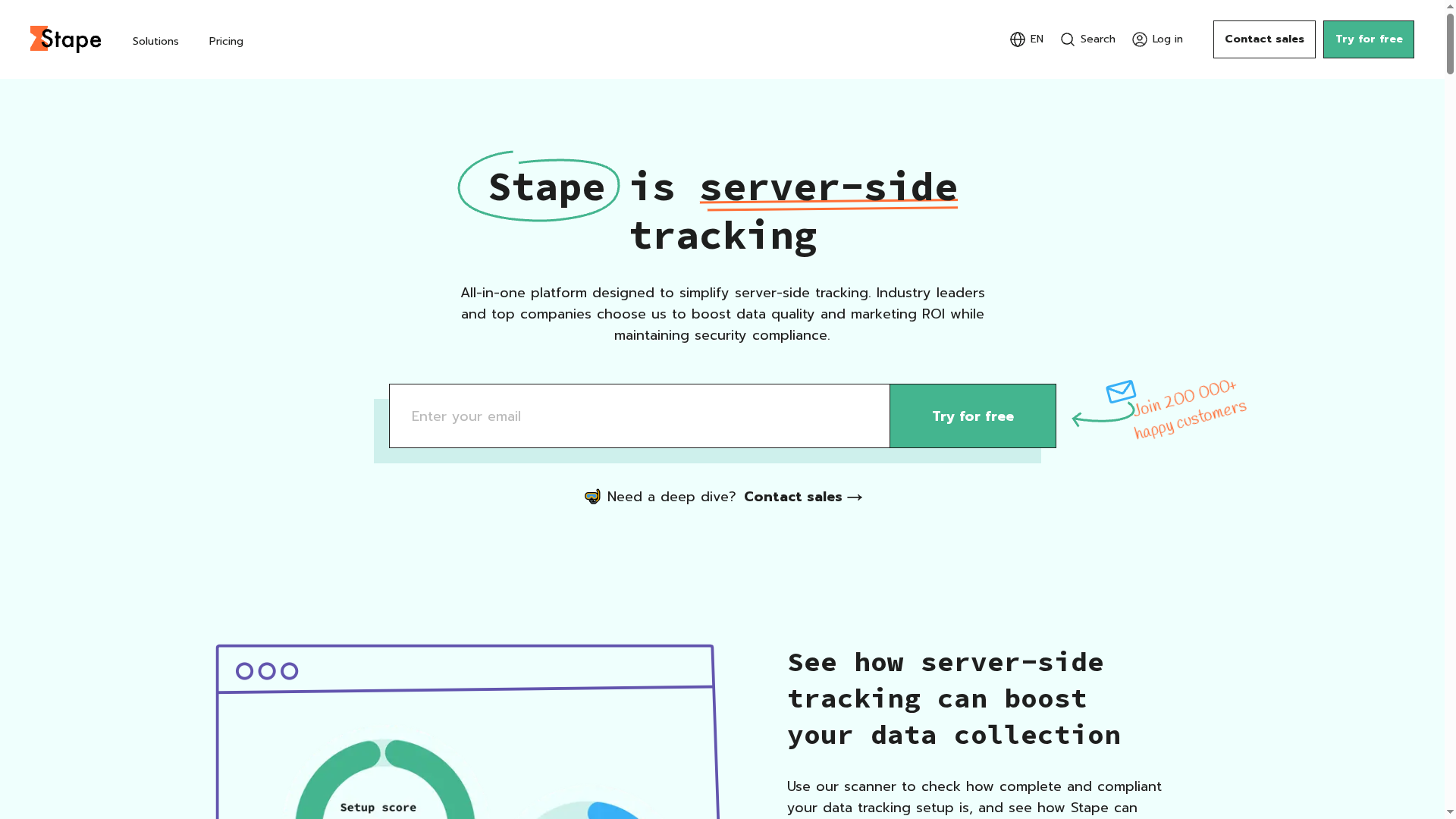
Stape is a focused platform for server-side tracking that simplifies deployment and strengthens data quality and privacy compliance. It supports major analytics and advertising gateways, offers automated scaling for traffic spikes, and provides enterprise-grade monitoring and custom solutions. If you need more reliable attribution and improved first‑party data capture without rebuilding your stack, Stape delivers a pragmatic route to cleaner signals. Beginners may face a learning curve, but technical teams will value the control.
Core Features
Stape’s core capabilities centre on server‑side tagging setup and hosting for Google Tag Manager plus a suite of API gateways for major platforms — Meta, TikTok and Snapchat — and a signals gateway for broader data connections. It emphasises first‑party data and cookieless tracking, includes data security measures such as anonymisation and GDPR compliance, and automatically scales resources during traffic spikes. Monitoring, debugging tools and enterprise customisable solutions complete the platform, with free trials available for one‑click integrations to help you validate setup before committing.
Pros
- Simplifies server‑side tracking setup with hosted Google Tag Manager containers and guided integrations, which reduces engineering overhead for marketing teams.
- Supports multiple platforms and gateways, enabling unified conversion tracking across Meta, TikTok, Snapchat and other measurement endpoints in one place.
- Provides automation and scaling features so your tracking remains resilient during traffic surges without manual intervention.
- Enhances data privacy and security by offering anonymisation and GDPR‑aligned controls, which helps with compliance and reduces risk.
- Offers support and customisable enterprise solutions, meaning larger organisations can adapt the platform to complex architectures and compliance needs.
Cons
- Based on the website content, potential complexity might be involved for complete beginners, which could require developer support or onboarding assistance.
- Pricing details are not extensively specified on public pages, so total cost may vary with traffic, integrations and enterprise requirements and require direct consultation.
- Specific limitations or restrictions are not mentioned, making it harder to evaluate edge cases such as extreme custom event schemas or very niche platform integrations.
Who It’s For
Stape is aimed at marketing and analytics professionals, technical teams and enterprises that need dependable server‑side tracking without rebuilding their entire data pipeline. It suits organisations prioritising privacy, accurate attribution and scalable tracking — particularly where first‑party data strategies and GDPR compliance are important. If you have some developer capacity or access to technical support, you will extract most value.
Unique Value Proposition
Stape’s unique value lies in packaging hosted server‑side Google Tag Manager, platform‑specific API gateways and privacy‑first features into a single workflow. That reduces signal loss, centralises conversion routing and automates scaling, which directly improves attribution accuracy and marketing ROI.
Real World Use Case
A retailer implementing server‑side tracking across Google Analytics, Meta and TikTok can migrate key conversion events to Stape, eliminate client‑side signal gaps, and combine first‑party identifiers to improve ROAS and reduce CPA — all while retaining GDPR compliance and handling peak traffic without dropping events.
Pricing
Stape offers a freemium plan at $0 and a starter plan from $20 per month, with custom solutions available for high‑traffic and enterprise requirements.
Website: https://stape.io
Taggrs.io
At a Glance
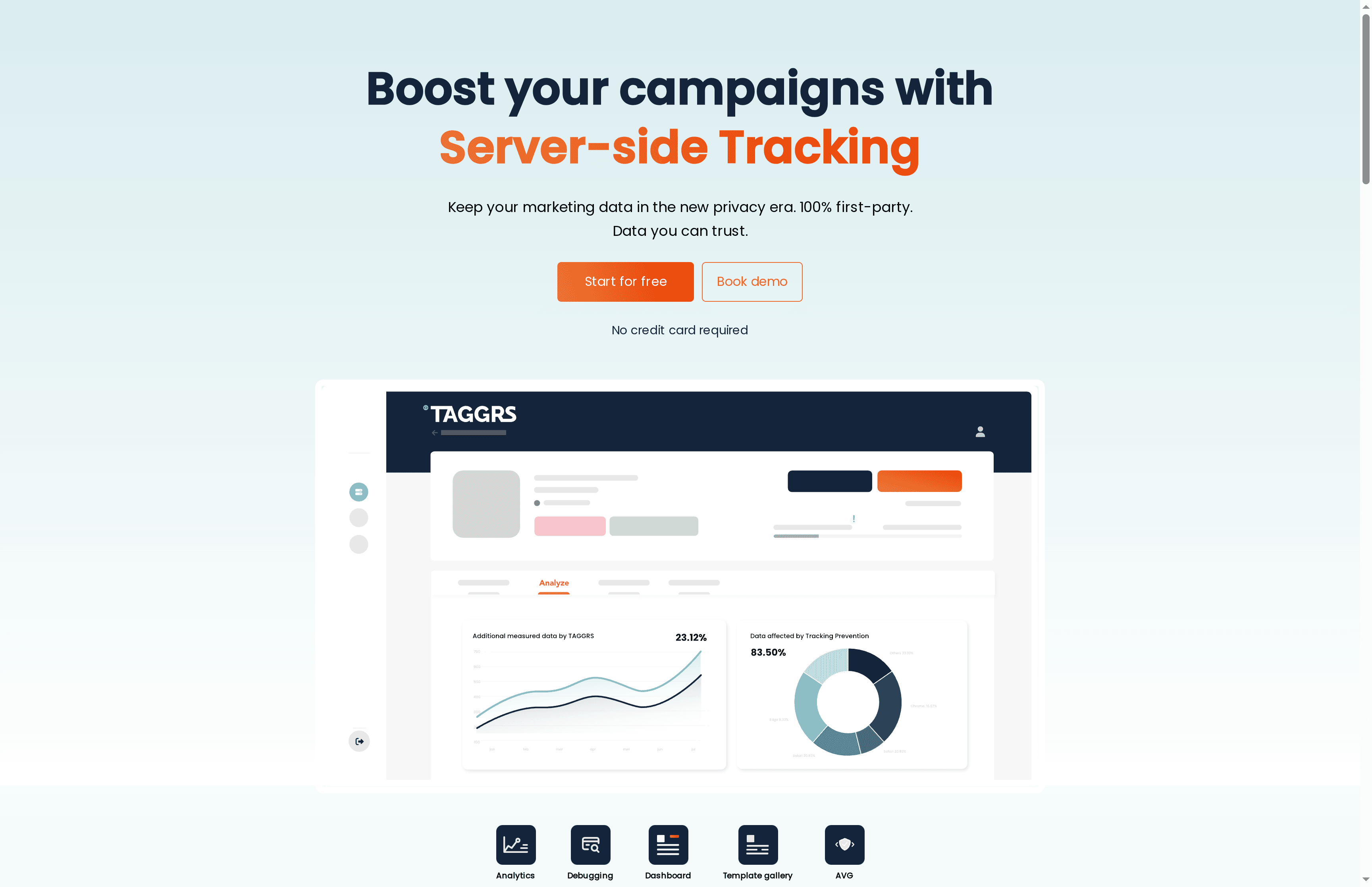
Taggrs.io is a server-side tracking platform that prioritises privacy, ease of setup and compatibility with mainstream tag managers. It ships with pre-built templates and guided resources to get basic tracking live quickly, while offering scalable plans that suit agencies through to enterprise teams. If you need reliable first-party data collection and GDPR tooling without heavy engineering, Taggrs.io is a pragmatic choice. There are trade-offs: technical constraints and enterprise demo options are not fully documented.
Core Features
Taggrs.io centres on server-side tracking technology with automatic integration for Google Tag Manager and compatibility with conversion APIs such as Meta’s. It provides pre-built free templates to accelerate deployment, multi-domain support for agencies, GDPR compliance tools and hosting that is independent from major cloud providers. The platform also lists flexible pricing tiers, enterprise custom solutions and ongoing product documentation plus chat and email support to help with onboarding and maintenance.
Pros
- Fast setup with templates: The pre-built templates and guided resources reduce implementation time and lower the barrier for non-technical teams to adopt server-side tracking.
- Strong tool compatibility: Native integration with Google Tag Manager and support for conversion APIs means Taggrs.io fits into most existing martech stacks without wholesale rework.
- Privacy-first approach: Built-in GDPR compliance tools and a focus on first-party data collection help you reduce reliance on third-party cookies while keeping data governance front of mind.
- Affordable entry and scalable plans: A free basic package and tiered pricing mean small teams can experiment before committing to paid tiers as volume grows.
- Support and documentation: Chat and email support alongside regular product updates make it easier to resolve issues and keep implementations current.
Cons
- Sparse technical detail: The public materials provide limited information about specific technical constraints such as latency, data retention or throughput limits.
- Enterprise trial ambiguity: Apart from the free plan, there is no clear mention of formal trial periods or guided demos for enterprise customers, which may complicate procurement decisions.
- Potential pricing complexity: Multiple tiers and custom enterprise pricing could be overwhelming for teams that prefer simple, flat-rate billing.
Who It’s For
Taggrs.io is best suited to marketing professionals, tracking specialists and agencies that need dependable server-side tracking with privacy controls and scalable plans. If your priority is improving attribution accuracy for paid campaigns while remaining GDPR-compliant, Taggrs.io provides a solid balance of usability and capability without requiring a large engineering investment.
Unique Value Proposition
Taggrs.io’s value lies in combining server-side reliability with straightforward onboarding: templates, GTM integration and privacy tooling in one package. Hosting independence from major cloud providers and a clear focus on first-party data collection make it a differentiated option for organisations wanting control over data flows and compliance.
Real World Use Case
A digital marketing agency used Taggrs.io to centralise server-side tracking across multiple client domains, which improved campaign measurement for Google Ads and GA4 while ensuring GDPR-aligned data handling. The agency reported clearer conversion signals and easier multi-domain management after implementation.
Pricing
Plans range from a free basic package that includes 10,000 requests to premium tiers at €57/month, with custom enterprise solutions available for larger needs and discounts for annual billing.
Website: https://taggrs.io
Twilio Segment

At a Glance
Twilio Segment is a mature customer data platform that centralises clean, consented customer data to enable real-time insights and personalised experiences. It excels at building unified customer profiles and activating data across a very large ecosystem of destinations. For medium to large organisations that can invest in setup and engineering, it delivers powerful automation and AI capabilities; for smaller teams, cost and complexity can be limiting factors.
Core Features
Segment brings together profile enrichment, data unification, real-time event tracking and activation across destinations. The platform advertises integrated AI features — including predictive and generative AI — alongside robust data governance and privacy controls. A standout capability is its breadth of integrations: over 700 pre-built connectors that link to data warehouses, marketing tools and messaging platforms, allowing you to orchestrate data flows without rebuilding pipelines from scratch.
Simple. Powerful.
Pros
- Comprehensive data integration and unification: Segment consolidates disparate event streams into single customer profiles, reducing fragmentation and making downstream analytics more reliable.
- Supports real-time personalisation and automation: Real-time event tracking enables immediate activation for campaigns and product personalisation, improving responsiveness to customer behaviour.
- Rich ecosystem of pre-built integrations: With 700+ destinations, you can connect many common marketing and analytics systems without bespoke engineering.
- Enterprise-grade security and privacy features: The platform includes governance controls to help manage consent and compliance, which is critical for regulated sectors.
- Flexible plans suited for various business sizes: There are tailored plans and a 14-day free trial for certain tiers, allowing organisations to evaluate the platform before committing.
Cons
- Complex setup for some advanced features: Implementing profile enrichment and AI-driven audiences often requires significant engineering effort and careful event modelling.
- Pricing may be high for small businesses or startups: The total cost of ownership can escalate once you factor in data volume, connectors and enterprise features.
- Requires technical expertise for maximum utilisation: Marketing teams will typically need engineering support to configure sources, maintain schema, and fully leverage AI capabilities.
Who It’s For
Segment is best suited to medium and large businesses that need a single source of truth for customer data and have the technical resources to implement it. If your goal is enterprise-level personalisation, cross-channel orchestration and granular data governance, Segment provides the tools to scale those efforts.
Unique Value Proposition
Segment’s unique value lies in combining extensive connector coverage with real-time activation and integrated AI, all while emphasising data governance. That mix allows organisations to unify data at scale and turn it into actionable audiences and predictions without building pipelines from scratch.
Real World Use Case
A healthcare organisation can track patient interactions across web, mobile and call-centre channels, unify those signals into rich profiles, then use AI-driven audiences to personalise communications — improving engagement while maintaining consent and privacy controls.
Pricing
Contact sales for custom pricing; a 14-day free trial is available for certain plans.
Website: https://segment.com
Wicked Reports

At a Glance
Wicked Reports is a multi-touch marketing attribution platform built for digital marketing agencies and advanced media buyers who need precision. It ties conversions and revenue to channels with customisable attribution models, automated insights and direct integrations with Google and Meta to improve conversion fidelity. The platform claims over 10 years of experience and $10 billion in attributed revenue, which underlines its focus on measurable ROI. Expect a steep but rewarding setup and a pricing structure geared towards businesses with meaningful ad spend.
Core Features
Wicked Reports delivers accurate marketing attribution across multiple channels, with customisable attribution models that map to your business KPIs. Automated insights and optimisation suggestions reduce manual analysis time while integrations with Google and Meta improve conversion data quality. Reporting centres on transparent ROAS and CAC metrics tied to revenue integrations and order IDs, all surfaced in detailed dashboards and reports designed to link spend directly to revenue.
Pros
- Highly accurate attribution with transparent reporting: the platform emphasises clear ROAS and CAC figures tied directly to revenue data, which helps justify spend decisions.
- Robust customisation options to match business KPIs: you can adapt attribution models to your specific customer journeys rather than relying on one-size-fits-all rules.
- Automation tools for insights and decision-making: automated analysis and alerts speed up optimisation and reduce time spent digging through raw data.
- Time savings through automated data analysis and reporting: recurring reports and dashboards free teams to act on insights rather than generate them.
- Flexible plans scaled to revenue stages, supporting growth and international operations: pricing tiers align with annual revenue to serve businesses from growing agencies to enterprise advertisers.
Cons
- Pricing complexity with multiple tiers and add-ons: the tiered, revenue-based pricing can be hard to model and may surprise teams that expect flat-rate plans.
- May require some setup and configuration to maximise value for advanced needs: getting the most accurate attribution typically needs careful mapping of conversions and revenue integrations.
- Less emphasis on traditional web analytics comparison in the provided content: there is limited contextualisation versus tools such as traditional analytics platforms, which may leave some teams unsure how Wicked Reports complements existing stacks.
Who It’s For
Wicked Reports suits advanced digital marketers, media buyers and agencies that demand detailed, customisable attribution and automated insights to optimise ad spend. If you run multi-channel campaigns and need revenue-level clarity on ROAS and CAC, this solution is aimed at you.
Unique Value Proposition
Wicked Reports differentiates itself by combining multi-touch attribution with revenue-level reporting and automated recommendations, backed by more than a decade of use and $10 billion in attributed revenue. That focus on tying order IDs and revenue integrations to channel performance is its central selling point.
Real World Use Case
An agency connects Facebook, Google and other platforms to Wicked Reports to consolidate conversion data, attribute revenue to specific campaigns and receive automated alerts that inform budget shifts. The result: more precise spend, improved campaign profitability and strategic reallocations based on revenue rather than clicks.
Pricing
Plans are based on annual revenue and start at $499/month for Measure, $699/month for Scale, $999/month for Maximize, and enterprise options begin at $4,999/month.
Website: https://wickedreports.com
Rockerbox
At a Glance
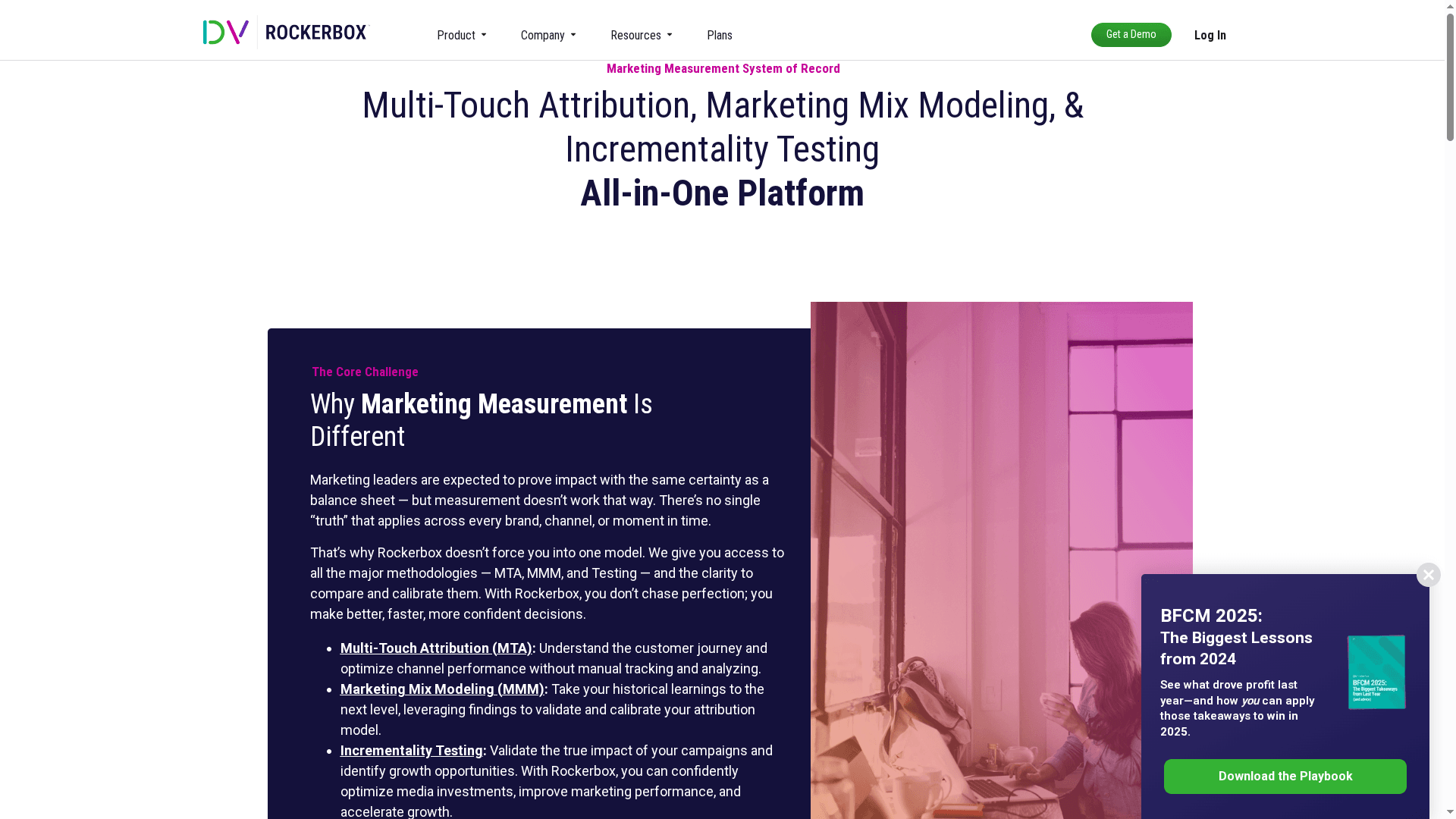
Rockerbox is a sophisticated marketing measurement platform that brings multi-touch attribution (MTA), marketing mix modelling (MMM) and incrementality testing into a single, SOC 2-certified data foundation. It helps enterprise teams compare methodologies, see where results align or diverge, and act on evidence rather than hunches. For organisations with complex online and offline channels, Rockerbox centralises messy data and makes rigorous measurement practical. It is powerful — but it assumes you have the data maturity or access to professional services to get the most from it.
Core Features
Rockerbox combines three distinct measurement approaches: multi-touch attribution to map customer journeys, marketing mix modelling to leverage historical trends, and incrementality testing to quantify true campaign lift. The platform centralises marketing data across channels, aggregates and cleans inputs, and operates as an open platform that can push results to data warehouses or ingest partner and internal models. Together, these capabilities let marketing and analytics teams triangulate insights, calibrate models, and reconcile differences between methodologies.
Pros
- Unified measurement methodologies: Rockerbox provides MTA, MMM and incrementality testing within one platform, which reduces the need to stitch separate tools together.
- Centralises cross-channel data: The product aggregates online and offline sources to eliminate silos, making whole-customer measurement more attainable.
- Flexible methodology mix: You can use one, two or all three methodologies depending on the question you need to answer, offering pragmatic adaptability for different campaigns.
- Robust compliance posture: Built with SOC 2 certification and GDPR alignment, Rockerbox prioritises trust and data governance for enterprise customers.
- Broad integration support: The platform supports integration with more than 100 marketing data sources, easing ingestion and connectivity efforts.
Cons
- No explicit product flaws documented: The provided material does not list specific feature limitations or recurring user complaints about the product.
- May require professional services: Onboarding, custom model configuration and interpretation of complex results frequently call for professional services, which adds time and cost.
- Implementation complexity varies: Depending on your existing data infrastructure, implementation can be non-trivial and may need significant engineering effort.
Who It’s For
Rockerbox is best suited to enterprise marketing teams and data practitioners who need a comprehensive, flexible measurement solution. If your organisation runs campaigns across multiple online and offline channels, has in-house analysts or access to consultancy support, and seeks to move from fragmented reporting to unified, test-backed decisions, Rockerbox is a natural fit.
Unique Value Proposition
Rockerbox’s core promise is methodological clarity: it doesn’t force a single answer but shows where MTA, MMM and incrementality converge and where they disagree, backed by a centralised, governed data foundation. That transparency helps teams choose confidently between attribution models and real-world test results.
Real World Use Case
A large brand consolidates disparate online and offline marketing feeds into Rockerbox, uses MMM to set baseline media elasticities, applies MTA to optimise channel journeys, and runs incrementality tests to validate campaigns — ultimately calibrating spend to save millions and materially improve marketing efficiency.
Pricing
Pricing information is not explicitly provided in the source material; prospective buyers should contact Rockerbox for tailored enterprise pricing and professional services estimates.
Website: https://rockerbox.com
Marketing Data Tools Comparison
This table provides a comprehensive overview of marketing data tools, summarizing key features, pros, cons, pricing, and suitable users for each platform.
| Tool | Key Features | Pros | Cons | Pricing |
|---|---|---|---|---|
| adpage.io | Server-side tagging, AI analysis, done-for-you setup, Shopify/WooCommerce integrations | Comprehensive conversion coverage, fast onboarding, robust monitoring | Pricing not specified | Pricing on request |
| Stape | Server-side tracking, hosted GTM, API gateways, GDPR compliance | Simplifies tracking setup, supports multiple platforms, enhances data privacy | Potential complexity for beginners, variable pricing | Freemium, $20+/month |
| Taggrs.io | Pre-built templates, GTM integration, multi-domain support, GDPR tools | Fast setup, strong tool compatibility, privacy-first approach | Sparse technical detail, unclear enterprise trials | Free, €57+/month |
| Twilio Segment | Centralizes customer data, real-time insights, AI features, 700+ integrations | Comprehensive integration, real-time personalisation, enterprise-grade privacy | Complex setup, potentially high pricing | Custom pricing, free trial |
| Wicked Reports | Custom attribution models, automated insights, Google/Meta integrations | Accurate attribution, customization, automation tools | Complex pricing, setup may require effort | $499+/month |
| Rockerbox | MTA, MMM, incrementality testing, SOC 2 certification | Unified methodologies, cross-channel data centralization, flexible methodologies | Implementation may require professional services | Custom pricing |
Unlock Accurate Marketing Attribution with AdPage
Marketing attribution software often struggles with incomplete conversion data and tracking blind spots that lead to flawed campaign insights and wasted ad spend. If you are frustrated by unreliable reporting or lose conversions due to client-side tagging limitations, the need for a precise, server-side solution is clear. AdPage specialises in eliminating data loss by capturing 100 percent of your conversions through advanced server-side tagging and webhook technology. This ensures your marketing efforts are measured with clarity and confidence.
Key benefits include:
- Seamless integration with popular platforms such as Shopify, WooCommerce and Magento
- Expert onboarding that reduces setup complexity and accelerates your results
- Privacy-compliant tracking aligned with GDPR regulations
Discover how you can take control of your conversion data with AdPage’s powerful platform. Start transforming your marketing attribution today.
Ready to improve your marketing outcomes through precise, comprehensive conversion tracking Understand how server-side tagging can eliminate blind spots and help you confidently optimise every penny of your ad spend Explore the full range of AdPage’s features and start your journey at https://adpage.io/en now
Frequently Asked Questions
What features should I look for in marketing attribution software for 2025?
Look for features like multi-touch attribution, integration capabilities with existing marketing tools, and robust data privacy controls. Ensure the software can provide real-time insights and clearly visualise campaign performance to streamline decision-making processes.
How can marketing attribution software improve campaign performance?
Marketing attribution software helps identify which channels and strategies drive conversions, enabling firms to optimise their marketing spend. By analysing data from various touchpoints, you can focus on high-performing tactics and potentially increase your return on ad spend (ROAS) by up to 30% within a few months.
What is the importance of accuracy in marketing attribution?
Accuracy in marketing attribution ensures that every conversion is linked to the correct marketing channel, which is crucial for making informed decisions. Reliable data allows teams to justify budgets and refine strategies effectively, leading to smarter resource allocation and increased marketing effectiveness.
How long does it take to implement a marketing attribution solution?
The timeline for implementing a marketing attribution solution can vary based on the complexity of your existing systems, but most businesses can expect to be operational within 30 to 90 days. To expedite your setup, ensure you have necessary data and resources ready for integration ahead of time.
Can smaller businesses benefit from using marketing attribution software?
Yes, smaller businesses can greatly benefit from marketing attribution software as it provides insights into which marketing efforts yield the best results. By leveraging these insights, smaller firms can maximise their limited budgets and enhance their marketing strategies for better ROI.
What are common challenges when using marketing attribution software?
Common challenges include data integration from multiple sources, ensuring data accuracy, and adapting to new tools. To mitigate these issues, establish clear objectives and invest time in training staff, which can reduce onboarding hurdles and improve overall data utilisation.