


.png)

Nearly 80 percent of marketers say data is at the heart of their strategy, yet many still feel uncertain about where to begin or what truly drives results. Data-driven marketing stands out because it moves decision-making from guesswork to precision, helping businesses reach the right people at the right time. Understanding its fundamentals means learning how smarter use of information can unlock better campaigns, stronger customer connections, and higher returns.
Table of Contents
- Defining Data-Driven Marketing Fundamentals
- Types of Data in Digital Marketing
- How Server-Side Tagging Enhances Accuracy
- Implementing Data-Driven Strategies in E-Commerce
- Ensuring Data Compliance and Consent Management
- Common Challenges and Mistakes to Avoid
Key Takeaways
| Point | Details |
|---|---|
| Data-Driven Marketing | Employing comprehensive data analysis enhances decision-making and optimizes marketing strategies for improved engagement. |
| Types of Marketing Data | Understanding zero-party, first-party, second-party, and third-party data assists in creating effective and ethical marketing campaigns. |
| Server-Side Tagging Benefits | This method improves data accuracy and privacy compliance by processing data on servers, overcoming traditional tracking limitations. |
| Compliance and Consent Management | Transparent data practices and clear user consent are essential for ethical marketing and building customer trust. |
Defining Data-Driven Marketing Fundamentals
Data-driven marketing represents a strategic approach where businesses leverage comprehensive data analysis to guide marketing decisions and tactics. According to research from arxiv, this methodology emphasizes using abundant data to forecast market responses and optimise budget allocation, transforming traditional marketing practices into precise, measurable strategies.
At its core, data-driven marketing involves collecting, analysing, and interpreting multiple data points from various customer interactions. These data sources might include website analytics, social media engagement, purchase histories, demographic information, and customer feedback. The goal is to develop a nuanced understanding of consumer behaviour, preferences, and potential future actions. Understanding data analysis becomes crucial in transforming raw information into actionable marketing insights.
The fundamental components of a robust data-driven marketing approach typically include:
- Data Collection: Systematically gathering information from multiple touchpoints
- Data Analysis: Using statistical methods and advanced analytics to interpret collected data
- Insights Generation: Translating analysis into clear, actionable marketing strategies
- Continuous Optimisation: Regularly refining strategies based on ongoing data feedback
By embracing these principles, businesses can move beyond traditional spray-and-pray marketing techniques. As research from the Academy of Marketing Science indicates, data-driven approaches enable organisations to create more personalised, targeted marketing campaigns that significantly improve engagement and conversion rates.
Types of Data in Digital Marketing
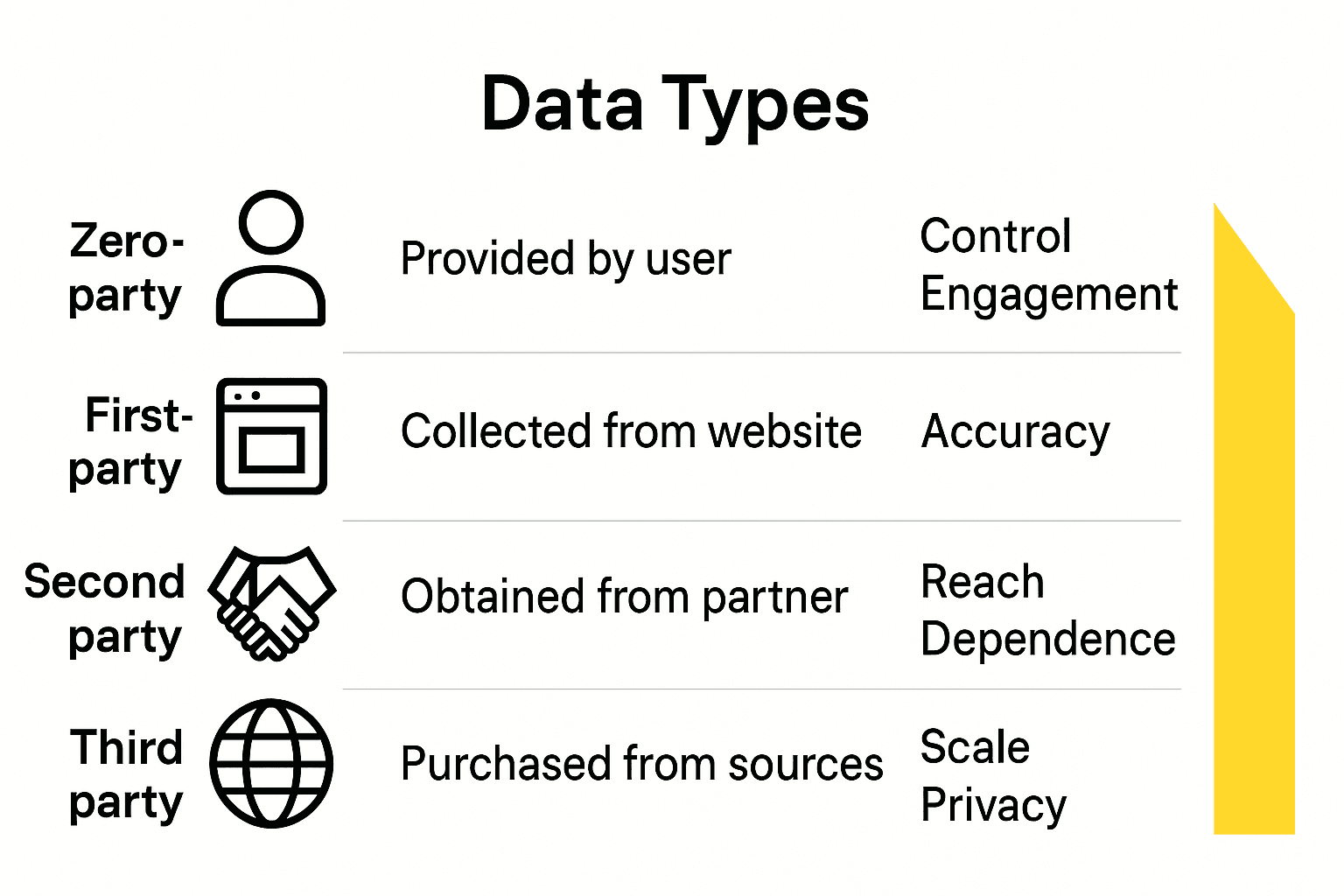
In the realm of digital marketing, understanding the diverse types of data is crucial for developing effective strategies. According to mautic, there are four primary categories of marketing data that businesses can leverage: zero-party, first-party, second-party, and third-party data. Each type offers unique insights and challenges for marketers seeking to understand and engage their target audience.
Zero-party data represents the most direct and transparent form of customer information, voluntarily shared by consumers themselves. This might include preference surveys, direct feedback, or intentional profile creation. First-party data is collected directly by a company through its own channels, such as website interactions, purchase histories, and app usage. In contrast, understanding how to interpret user data becomes critical in transforming these raw information sources into actionable marketing insights.
The nuances between different data types can be further distinguished:
- Zero-party data: Directly provided by customers with full consent
- First-party data: Collected through a company’s own platforms and interactions
- Second-party data: Information obtained through partnerships with another organisation
- Third-party data: Aggregated from external sources and data providers
Each data type presents unique advantages and considerations. Third-party data, while broad in scope, raises significant privacy concerns, whereas zero-party and first-party data offer more transparent and consensual insights. Successful digital marketers must carefully navigate these data landscapes, balancing comprehensive insights with ethical data collection practices and respecting individual privacy boundaries.
How Server-Side Tagging Enhances Accuracy
Server-side tagging represents a revolutionary approach to data collection that addresses many limitations of traditional client-side tracking methods. According to Adaglobal, this technique enhances data accuracy by reducing reliance on client-side data collection, providing marketers with more reliable and comprehensive insights into user interactions.
The core advantage of server-side tagging lies in its ability to overcome significant tracking challenges. Exploring the advantages of server-side tagging reveals how this method circumvents common obstacles like ad blockers, browser restrictions, and privacy settings that typically compromise data collection. As Newtarget notes, this approach dramatically improves data accuracy by processing tracking information on the server rather than relying on potentially unreliable client-side scripts.
Key benefits of server-side tagging include:
- Improved Data Accuracy: Reduces data loss from browser limitations
- Enhanced Privacy Compliance: Provides more secure data handling
- Better Performance: Reduces client-side processing load
- Advanced Tracking Capabilities: Overcomes traditional tracking restrictions
Moreover, server-side tagging offers marketers a more robust solution for tracking user interactions. By moving data processing to the server, businesses can capture more comprehensive and reliable data, ensuring that critical user insights are not lost due to technical limitations or privacy interventions. This approach represents a significant leap forward in digital marketing analytics, providing a more sophisticated and dependable method of understanding user behaviour.
Implementing Data-Driven Strategies in E-Commerce
E-commerce businesses are increasingly turning to sophisticated data-driven strategies to gain a competitive edge in the digital marketplace. According to research from arxiv, advanced data analysis techniques like unsupervised machine learning can revolutionize market segmentation, enabling businesses to develop highly personalized marketing approaches that dramatically improve customer engagement and conversion rates.
Data-driven strategy implementation requires a comprehensive approach that goes beyond basic analytics. Exploring e-commerce data strategies reveals that successful implementation involves multiple critical components. These include collecting granular customer data, developing sophisticated segmentation models, and creating targeted marketing campaigns that speak directly to specific customer personas.
Key steps for implementing data-driven strategies include:
- Customer Segmentation: Analyze demographic, behavioural, and transactional data
- Predictive Analytics: Forecast customer behaviour and potential purchasing patterns
- Personalization: Develop tailored marketing messages and product recommendations
- Continuous Optimization: Regularly refine strategies based on ongoing data insights
The ultimate goal of data-driven e-commerce strategies is to transform raw information into actionable insights that drive business growth. By leveraging advanced analytical techniques, businesses can create more meaningful customer experiences, optimize marketing spend, and ultimately increase revenue through precise, targeted approaches that resonate with individual customer needs and preferences.

Ensuring Data Compliance and Consent Management
In the rapidly evolving digital marketing landscape, data compliance and consent management have become critical priorities for businesses seeking to maintain ethical and legal data practices. According to Wikipedia, customer data platforms play a crucial role in creating unified customer databases while maintaining strict adherence to data protection regulations.
Consent management represents the cornerstone of responsible data collection and usage. Understanding consent management involves implementing robust systems that allow customers to control their personal information transparently. As highlighted by Wikipedia’s behavioural analytics research, privacy concerns are paramount in modern data collection strategies, making it essential for businesses to develop comprehensive consent frameworks.
Key principles of effective data compliance include:
- Transparent Data Collection: Clearly communicate what data is being collected
- Explicit Consent: Obtain clear, verifiable permission from users
- Data Minimization: Collect only necessary information
- User Control: Provide easy options to modify or withdraw consent
- Secure Storage: Implement robust protection mechanisms
Successful data compliance goes beyond mere legal requirements. It builds trust with customers by demonstrating a genuine commitment to protecting their personal information. By prioritizing transparent, user-controlled data practices, businesses can create a more ethical and sustainable approach to digital marketing that respects individual privacy while still delivering personalized, valuable experiences.
Common Challenges and Mistakes to Avoid
Data-driven marketing presents numerous potential pitfalls that can undermine even the most sophisticated strategies. According to Emeritus, businesses frequently encounter significant challenges related to data quality, integration complexities, and analytical interpretation that can derail their marketing efforts.
Data accuracy represents the foundational challenge in digital marketing analytics. Exploring common tracking mistakes reveals that many organisations struggle with inconsistent data collection methods and incomplete tracking frameworks. As highlighted by Wikipedia’s marketing mix modeling research, accurately estimating the impact of various marketing tactics requires meticulous attention to analytical nuances.
Common mistakes that marketers must proactively address include:
- Incomplete Data Collection: Failing to capture comprehensive user interactions
- Overreliance on Vanity Metrics: Focusing on superficial numbers instead of meaningful insights
- Inadequate Data Segmentation: Not breaking down data into actionable customer groups
- Ignoring Data Quality: Proceeding with analysis without verifying data accuracy
- Lack of Contextual Understanding: Interpreting data without proper contextual framework
Successful data-driven marketing demands a holistic approach that goes beyond simple number crunching. Marketers must develop a critical mindset, continuously questioning their assumptions, validating their data sources, and remaining adaptable in their analytical methodologies. By recognising and proactively addressing these common challenges, businesses can transform potential obstacles into opportunities for more sophisticated, nuanced marketing strategies.
Unlock the Full Potential of Your Data-Driven Marketing Strategy
Navigating the complex world of data-driven marketing can feel overwhelming, especially when faced with challenges like inaccurate tracking, data loss, and consent management hurdles. This article highlights the critical need for precise data collection and continuous optimisation to truly understand customer behaviour and maximise conversion rates. If you want to move beyond guessing games and embrace accurate, reliable insights, server-side tagging is an essential solution.
Discover how AdPage empowers marketing agencies and e-commerce businesses with advanced server-side tagging technology that ensures you capture 100 percent of conversions, even amid browser restrictions or ad blockers. With seamless integration for platforms like Shopify, WooCommerce, and Magento, plus strong compliance with GDPR through intuitive consent management tools, AdPage makes elevating your data-driven marketing both simple and effective. Start transforming your marketing analytics today by visiting AdPage Server-Side Solutions and take control of your data accuracy before the competition does.
Frequently Asked Questions
What is data-driven marketing?
Data-driven marketing is a strategic approach that uses data analysis to inform marketing decisions and strategies, aiming to enhance accuracy and effectiveness by understanding consumer behavior and preferences.
What types of data are used in digital marketing?
The four main types of data in digital marketing are zero-party data, first-party data, second-party data, and third-party data, each providing unique insights into customer behavior and preferences.
How does server-side tagging improve data accuracy?
Server-side tagging enhances data accuracy by processing user tracking information on the server rather than relying on client-side scripts, reducing data loss from browser limitations and improving privacy compliance.
What are some common challenges in data-driven marketing?
Common challenges include maintaining data accuracy, dealing with integration complexities, ensuring comprehensive data collection, and interpreting data correctly to derive meaningful insights.