


.png)

Managing accurate conversion tracking feels more challenging as privacy tools and browser restrictions evolve, leaving data gaps that impact your advertising results. For E-commerce marketing managers, finding reliable solutions to these issues is essential to ensure consistent growth and informed decision-making. This article delivers clarity on server-side tagging, explaining how it empowers mid-sized online retailers to enhance data precision, comply with global privacy standards, and gain deeper campaign insights.
Table of Contents
- Defining Google Ads Server And Core Concepts
- How Server-Side Tagging Enhances Tracking
- Key Features For E-Commerce Marketers
- Implementing Consent Management And Gdpr Compliance
- Comparing Server-Side And Client-Side Tracking
- Pitfalls To Avoid When Using Google Ads Server
Key Takeaways
| Point | Details |
|---|---|
| Importance of Google Ads | Google Ads is a powerful platform for targeted online advertising, allowing businesses to reach specific customer demographics effectively. |
| Benefits of Server-Side Tracking | Server-side tagging enhances data accuracy and performance while improving privacy compliance compared to traditional client-side methods. |
| Consent Management Importance | Effective consent management is crucial for maintaining user trust and ensuring GDPR compliance in e-commerce. |
| Avoid Common Pitfalls | Marketers should strategically manage keyword targeting and performance monitoring to maximise the effectiveness of Google Ads server tracking solutions. |
Defining Google Ads Server And Core Concepts
In the dynamic world of digital advertising, Google Ads represents a sophisticated platform enabling businesses to connect with potential customers through targeted online advertising. Fundamental advertising technology allows advertisers to place strategic advertisements across multiple digital channels, leveraging advanced targeting mechanisms.
At its core, Google Ads operates on a pay-per-click model where businesses bid to display advertisements in search results, websites, and mobile applications. The platform’s sophisticated server infrastructure enables precise tracking and delivery of ads based on complex user behaviour and demographic data. Key components of this system include:
- Keyword Targeting: Matching advertisements with specific search queries
- Bidding Mechanisms: Determining ad placement and cost
- Audience Segmentation: Filtering potential customers by interests and behaviours
- Performance Tracking: Measuring ad effectiveness through detailed metrics
The technical architecture behind Google Ads involves intricate server-side tracking systems that capture and analyse user interactions with unprecedented granularity. These systems process millions of data points instantaneously, enabling real-time ad optimisation and performance assessment.
This table summarises key business impacts of Google Ads server features:
| Feature | Main Benefit | Typical Business Impact |
|---|---|---|
| Keyword Targeting | Ensures relevant ad placements | Increases qualified website traffic |
| Performance Tracking | Measures campaign effectiveness | Informs budget and creative decisions |
| Audience Segmentation | Targets specific groups efficiently | Boosts campaign ROI and retention |
| Bidding Mechanisms | Optimises ad spend allocation | Reduces wasted budget, maximises results |
Server-side tracking provides more accurate and comprehensive data collection compared to traditional client-side methods.
Pro tip: Configure your Google Ads server settings to maximise data accuracy and minimise tracking discrepancies.
How Server-Side Tagging Enhances Tracking
Server-side tagging represents a sophisticated approach to digital tracking that fundamentally transforms how e-commerce businesses collect and analyse user data. By shifting critical tracking processes from client-side browsers to secure server environments, businesses can achieve unprecedented levels of data accuracy and reliability.
Traditional client-side tracking relies on browser-based scripts, which are vulnerable to numerous disruptions such as ad blockers, browser privacy settings, and intermittent internet connections. Advanced tracking methodologies enable businesses to overcome these limitations by processing tracking events directly on their servers, ensuring comprehensive data capture regardless of client-side constraints.
The key advantages of server-side tagging include:
- Enhanced Data Reliability: Reduces tracking interruptions and data loss
- Improved Privacy Compliance: Enables better management of user consent
- Superior Performance: Minimises website loading delays caused by multiple tracking scripts
- Advanced Security: Protects sensitive tracking information from client-side vulnerabilities
Unlike traditional tracking methods, server-side approaches provide granular control over data collection processes. By routing tracking events through secure server infrastructure, businesses can implement more sophisticated tracking strategies that capture nuanced user interactions with unprecedented precision.
Server-side tagging transforms raw user interactions into actionable, comprehensive tracking insights.
Pro tip: Implement comprehensive consent management alongside server-side tracking to ensure robust data collection and regulatory compliance.
Key Features For E-Commerce Marketers
E-commerce marketing requires sophisticated digital tools that enable precise targeting, measurement, and optimisation of advertising campaigns. Digital marketing fundamentals emphasise the critical importance of understanding and leveraging advanced technological capabilities to drive business growth and customer engagement.
Modern e-commerce marketers need a comprehensive toolkit that goes beyond traditional advertising approaches. The most effective marketing strategies integrate multiple features to create a holistic approach to customer acquisition and retention. These features encompass several key strategic domains:
- Audience Targeting: Precision segmentation based on demographics, interests, and behaviours
- Performance Analytics: Real-time tracking and measurement of campaign effectiveness
- Conversion Optimisation: Tools to enhance user journey and improve purchase probability
- Cross-Channel Integration: Seamless marketing across multiple digital platforms
- Dynamic Remarketing: Personalised ad experiences for potential customers
Advanced tracking technologies enable marketers to develop nuanced understanding of customer interactions. By combining server-side tracking with sophisticated analytical tools, businesses can create more intelligent, responsive marketing strategies that adapt to changing user behaviours and preferences.
Successful e-commerce marketing requires continuous learning and technological adaptation.
Pro tip: Integrate multiple data sources to create a comprehensive view of your customer’s digital journey and personalise marketing approaches accordingly.
Implementing Consent Management And GDPR Compliance
Consent management represents a critical framework for e-commerce businesses navigating the complex landscape of digital privacy regulations. Comprehensive consent management requires a strategic approach that balances user privacy protection with effective data collection and marketing capabilities.
Successful GDPR compliance demands a multifaceted approach that goes beyond simple checkbox solutions. E-commerce businesses must develop robust systems that provide transparent, granular consent mechanisms while maintaining user trust and operational flexibility.
Key components of effective consent management include:
- Clear Communication: Explicit, understandable explanations of data usage
- Granular Consent Options: Allowing users to select specific data processing preferences
- Easy Withdrawal Mechanisms: Simple processes for users to modify or revoke consent
- Secure Data Storage: Protecting collected consent information with advanced security protocols
- Audit Trail Maintenance: Documenting consent interactions for regulatory compliance
Implementing a sophisticated consent management system requires careful consideration of technical infrastructure and user experience design. Businesses must create intuitive interfaces that empower users to make informed decisions about their personal data while maintaining seamless digital interactions.
Effective consent management transforms data privacy from a regulatory burden into a competitive advantage.
Pro tip: Develop a consent management strategy that prioritises user transparency and provides clear, accessible options for data control.
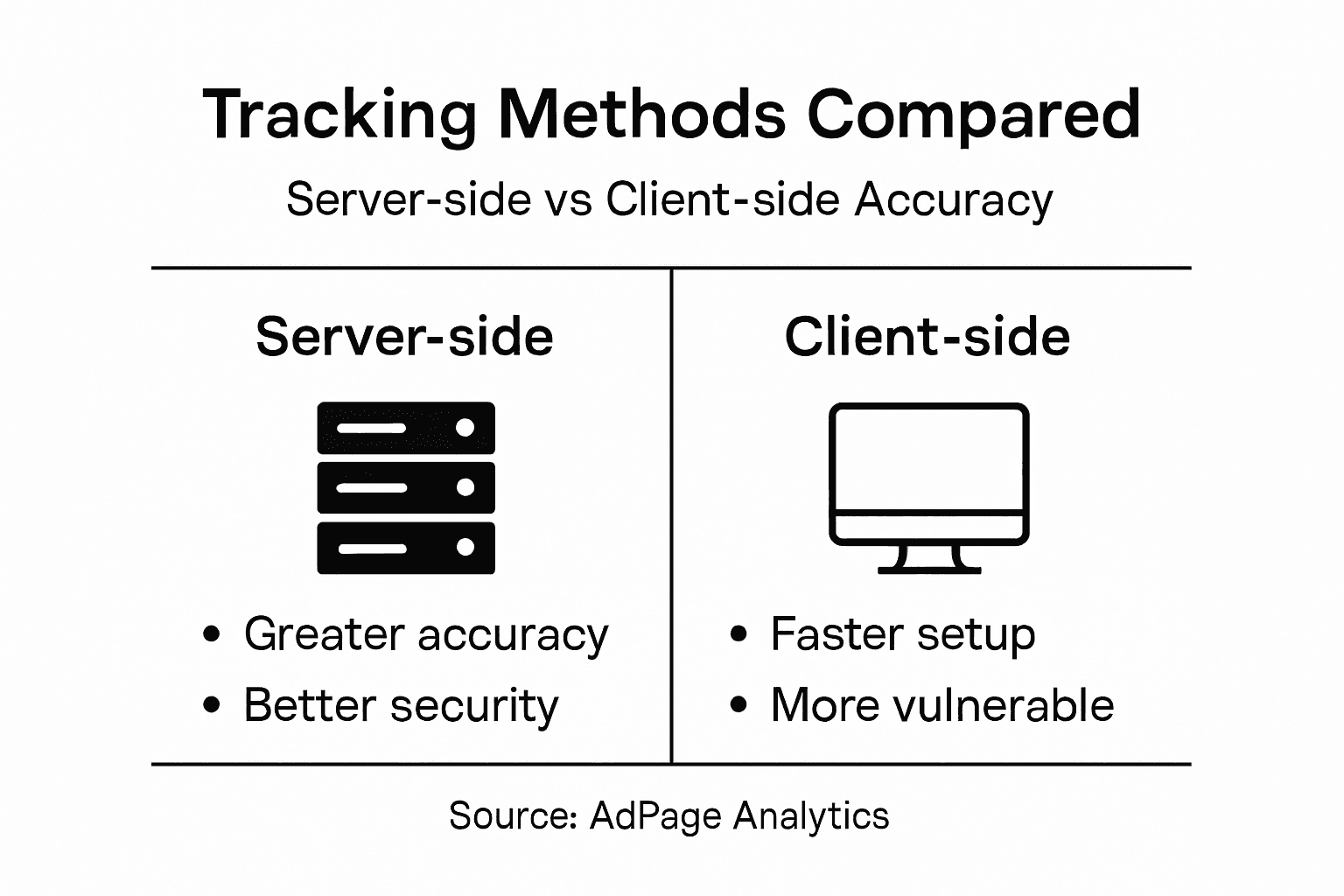
Comparing Server-Side And Client-Side Tracking
Digital tracking technologies represent a critical infrastructure for understanding user interactions, with server-side and client-side tracking offering distinct approaches to data collection and analysis. Web rendering techniques demonstrate the nuanced differences between these methodological approaches, highlighting their unique strengths and potential limitations.

Client-side tracking traditionally relies on browser-based scripts that execute directly within a user’s web browser, enabling dynamic interaction tracking but introducing significant vulnerabilities. These tracking methods are susceptible to numerous disruptions such as ad blockers, browser privacy settings, and inconsistent internet connections.
Key comparative characteristics include:
- Data Reliability: - Server-side: High accuracy, minimal data loss
- Client-side: Prone to interruptions and tracking gaps
- Performance Impact:
- Server-side: Minimal website loading delays
- Client-side: Potential performance degradation
- Privacy Compliance:
- Server-side: Enhanced control and security
- Client-side: More vulnerable to privacy breaches
- Technical Complexity:
- Server-side: Higher initial implementation requirements
- Client-side: Simpler initial setup
The evolving digital landscape increasingly favours server-side tracking as businesses prioritise data accuracy, user privacy, and comprehensive analytical capabilities. By processing tracking events on secure server infrastructure, organisations can mitigate the inherent limitations of traditional client-side methods.
Here is a clear comparison of client-side versus server-side tracking for e-commerce businesses:
| Aspect | Client-Side Tracking | Server-Side Tracking |
|---|---|---|
| Resistance to blockers | Easily disrupted by ad blockers | Largely unaffected by client-side tools |
| Data control | Limited, dependent on browser features | Full, managed by server infrastructure |
| Implementation speed | Rapid setup, low technical demands | Requires planning and technical skills |
| Long-term scalability | May struggle as privacy changes evolve | Highly scalable with changing regulations |
Server-side tracking represents the future of sophisticated, privacy-conscious digital analytics.
Pro tip: Gradually transition tracking mechanisms, implementing server-side solutions incrementally to minimise disruption and maintain continuous data collection.
Pitfalls To Avoid When Using Google Ads Server
E-commerce marketers must navigate complex challenges when implementing Google Ads server tracking solutions. Client-side security risks represent a critical consideration that can compromise data integrity and user privacy if not carefully managed.
Common pitfalls in Google Ads server implementation can significantly undermine marketing effectiveness and create substantial operational vulnerabilities. These challenges often emerge from insufficient strategic planning, inadequate technical configuration, and overlooking critical performance parameters.
Key pitfalls marketers must proactively address include:
- Keyword Targeting Errors:
- Using overly broad keyword selections
- Neglecting negative keyword strategies
- Failing to refine audience segmentation
- Technical Configuration Risks:
- Inadequate data privacy controls
- Incomplete consent management frameworks
- Insufficient security protocol implementation
- Performance Monitoring Mistakes:
- Ignoring granular analytics
- Infrequent campaign performance reviews
- Neglecting conversion rate optimisation
Successful Google Ads server deployment requires a holistic approach that balances technical sophistication with strategic insight. Marketers must develop robust implementation strategies that prioritise data accuracy, user privacy, and continuous performance improvement.
Effective Google Ads server management demands proactive risk mitigation and continuous learning.
Pro tip: Conduct comprehensive security audits and implement multi-layered tracking validation processes to minimise potential tracking vulnerabilities.
Unlock Precise E-Commerce Tracking with Server-Side Tagging
The article highlights the critical challenge of inaccurate data collection caused by traditional client-side tracking methods such as disruptions from ad blockers and privacy settings. For marketing agencies and e-commerce professionals aiming to maximise conversion tracking accuracy and comply with GDPR, addressing these pain points is essential. Concepts like server-side tagging, consent management, and enhanced performance tracking are key to overcoming these obstacles and driving better campaign results.
AdPage offers a powerful solution designed specifically for these challenges. With robust server-side tagging tools, seamless integration with platforms like Shopify and WooCommerce, and comprehensive consent management frameworks, AdPage ensures you capture 100% of your conversions without losing valuable insights. Our platform empowers you to mitigate data loss while improving security and regulatory compliance all in one place.
Take control of your tracking accuracy today with AdPage’s solution. Discover how our features simplify complex Google Ads server configurations and enhance your digital marketing performance through server-side tagging capabilities.
Explore more and upgrade your tracking system now.
Optimize your e-commerce strategy with AdPage — where precise data meets performance.
Experience the future of conversion tracking on AdPage.
Take the first step to smarter marketing.
Take action now and transform your tracking accuracy.

Frequently Asked Questions
What is Google Ads Server and how does it work?
Google Ads Server is a sophisticated advertising platform that allows businesses to display targeted ads across various digital channels utilizing a pay-per-click model. It relies on advanced server infrastructure for precise ad tracking and delivery based on user behaviour and demographics.
How does server-side tagging improve tracking accuracy for e-commerce?
Server-side tagging enhances tracking accuracy by processing tracking events on secure servers instead of client-side browsers, which can be disrupted by ad blockers and privacy settings. This method offers improved data reliability and protects sensitive information.
What are the key benefits of using Google Ads for e-commerce marketing?
Google Ads offers benefits such as keyword targeting for relevant ad placements, performance tracking for measuring campaign effectiveness, and audience segmentation to efficiently reach specific groups. These features significantly boost website traffic and campaign ROI.
What common pitfalls should businesses avoid when using Google Ads Server?
Common pitfalls include using overly broad keyword selections, inadequate technical configurations, and neglecting to monitor campaign performance. To maintain effectiveness, it’s essential to refine audience segmentation and conduct regular reviews of campaign performance.