


.png)

More than 85 percent of British e-commerce campaigns face data gaps due to outdated tracking setups. For global marketing teams, precise conversion tracking is the backbone of competitive client strategies. Advanced Google Analytics methods, especially server-side configurations, now offer sharper user insights and stronger data reliability than ever. In this article, marketing professionals will discover how the latest analytics tools unlock more accurate conversion measurement and campaign success.
Table of Contents
- Google Analytics And Conversion Tracking Essentials
- Differences Between Client-Side And Server-Side Tracking
- Integrating Google Analytics With E-Commerce Platforms
- Ensuring Gdpr Compliance And Consent Management
- Common Measurement Pitfalls And How To Avoid Them
Key Takeaways
| Point | Details |
|---|---|
| Utilise Google Analytics 4 | Transitioning to GA4 offers advanced event tracking and insights into user interactions, enhancing conversion tracking capabilities. |
| Implement Server-Side Tracking | Adopting server-side tracking improves data accuracy and resilience against disruptions caused by ad blockers or privacy settings. |
| Integrate with E-commerce Platforms | Configure event-based tracking on e-commerce platforms to capture critical user interactions throughout the buying process. |
| Ensure GDPR Compliance | Develop a robust consent management framework to protect user data and comply with stringent EU regulations while collecting analytics. |
Google Analytics and Conversion Tracking Essentials
E-commerce professionals rely on Google Analytics as a critical tool for understanding user behaviour and measuring website performance. By tracking key metrics and dimensions, marketing teams can gain deep insights into conversion pathways, user interactions, and revenue generation strategies.
The transition from Universal Analytics to Google Analytics 4 (GA4) represents a significant advancement in conversion tracking capabilities. This new platform offers more sophisticated event tracking, allowing businesses to capture nuanced user interactions across multiple devices and platforms. Key features include advanced conversion goal setting, comprehensive sales funnel analysis, and the ability to identify top-performing web pages that drive user engagement.
Successful conversion tracking requires a strategic approach. Marketing professionals should focus on configuring precise conversion goals, implementing server-side tracking, and utilising multi-channel attribution models. This means looking beyond simple page views and understanding the complete customer journey from initial interaction to final purchase. By segmenting data and analysing user behaviour patterns, e-commerce teams can optimise marketing spend and improve overall website performance.
Pro tip: Configure custom event tracking in Google Analytics to capture specific user interactions that matter most to your e-commerce business, such as add-to-cart actions, product page views, and checkout initiation stages.
Differences Between Client-Side and Server-Side Tracking
Client-side tracking has traditionally been the standard method for web analytics, where tracking scripts execute directly within users’ web browsers. This approach relies on JavaScript to collect and transmit user interaction data, capturing events like page views, clicks, and scrolling behaviour. However, this method comes with significant limitations, particularly in scenarios involving ad blockers, browser privacy settings, and incomplete data capture.
In contrast, server-side tracking provides a more robust and comprehensive approach to analytics, enabling e-commerce businesses to capture user interactions more reliably. Server-side tracking processes data at the server level before transmission, which means it can bypass browser-based restrictions and capture more accurate, complete user journey information. This method offers enhanced data integrity, improved tracking accuracy, and greater resilience against technical interruptions or user privacy mechanisms.

The key differences between client-side and server-side tracking extend beyond technical implementation. Client-side tracking typically suffers from data loss due to ad blockers, browser extensions, and user privacy settings, whereas server-side tracking can collect data more consistently. Server-side solutions also provide better performance, reduced page load times, and more comprehensive data collection across multiple platforms and devices. E-commerce businesses leveraging server-side tracking can gain more nuanced insights into user behaviour, conversion paths, and marketing campaign effectiveness.
Here is a summary of the key differences between client-side and server-side tracking for e-commerce analytics:
| Aspect | Client-Side Tracking | Server-Side Tracking |
|---|---|---|
| Data Collection | Relies on browser scripts | Processes data on backend server |
| Data Accuracy | Affected by ad blockers | More resilient and consistent |
| Privacy Handling | Limited control mechanisms | Greater customisation for privacy |
| Technical Reliability | Susceptible to interruptions | Robust against disruptions |
| Tracking Coverage | May miss multi-device actions | Comprehensive cross-platform view |
Pro tip: Implement a hybrid tracking approach that combines both client-side and server-side methods to maximise data collection accuracy and comprehensiveness while respecting user privacy preferences.
Integrating Google Analytics with E-commerce Platforms
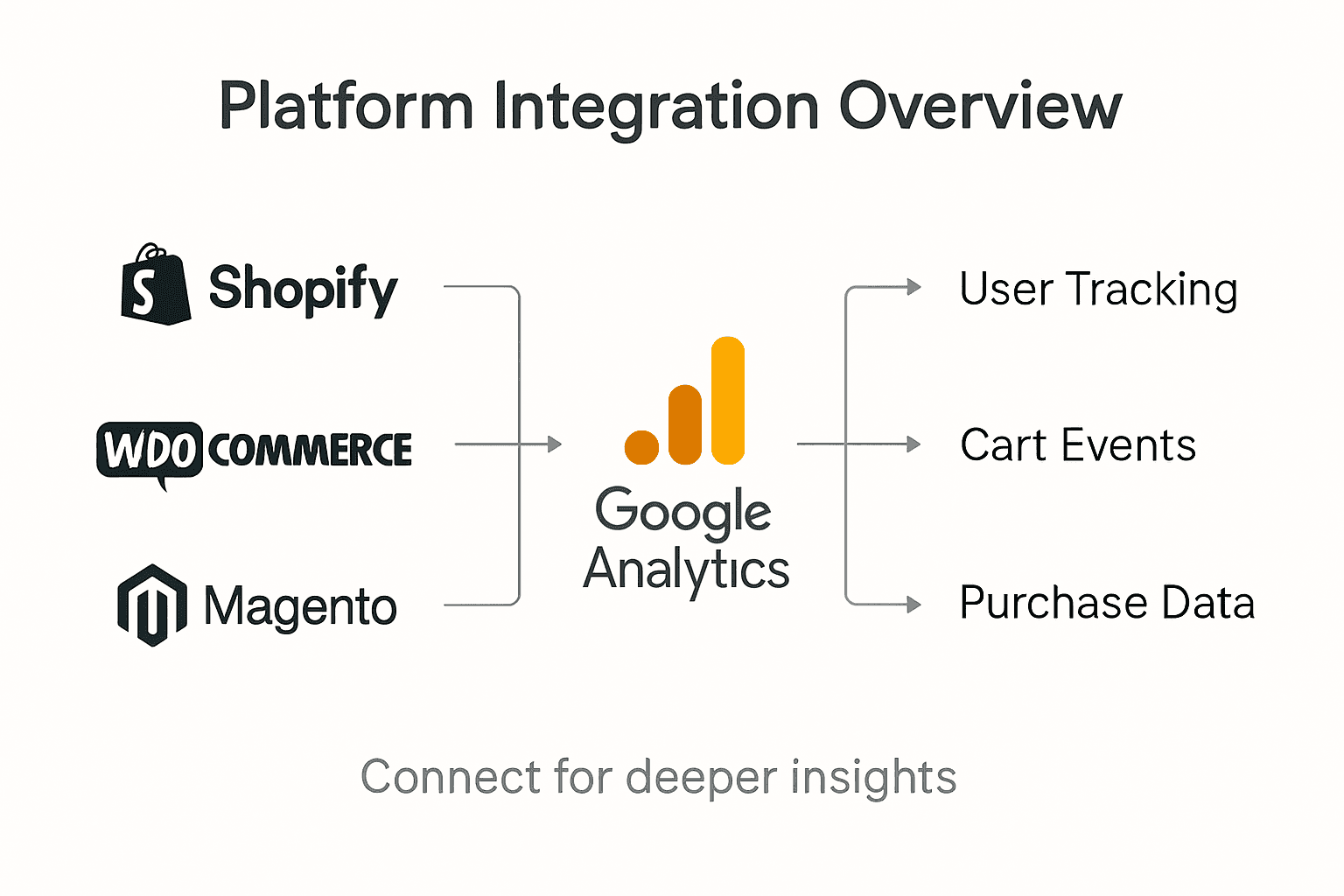
Google Analytics integration represents a critical strategy for e-commerce businesses seeking comprehensive insights into their digital performance. Configuring event-based tracking across e-commerce platforms enables marketers to capture detailed user interactions, from initial product views through to final purchase transactions. This process involves implementing specialised tracking codes and event parameters that map the entire customer journey.
Most popular e-commerce platforms like Shopify, WooCommerce, and Magento offer native Google Analytics integration, simplifying the technical implementation process. Successful integration requires careful configuration of conversion goals, enhanced e-commerce tracking, and custom event parameters. Marketing professionals must focus on mapping specific user actions such as product page views, add-to-cart events, checkout initiations, and completed purchases to create a comprehensive understanding of customer behaviour and sales funnel dynamics.
Advanced integration strategies go beyond basic tracking, incorporating sophisticated features like user segmentation, conversion path analysis, and real-time performance monitoring. By leveraging Google Analytics 4’s event-based model, e-commerce businesses can gain granular insights into customer preferences, identify potential friction points in the purchasing process, and develop data-driven strategies to improve overall conversion rates. This approach transforms raw data into actionable intelligence that can drive strategic marketing decisions and enhance online sales performance.
Pro tip: Configure custom event tracking for each critical stage of your e-commerce funnel to capture nuanced user interactions and understand precisely where potential customers might be abandoning their purchase journey.
Ensuring GDPR Compliance and Consent Management
E-commerce businesses operating within the European Union must navigate complex data protection requirements, with General Data Protection Regulation (GDPR) establishing stringent guidelines for user data collection and analytics. Legal bases for processing analytics data demand explicit user consent and comprehensive privacy protections, requiring businesses to implement sophisticated consent management strategies that go beyond simple checkbox mechanisms.
Successful GDPR compliance involves implementing multi-layered consent frameworks that provide users with granular control over their personal data. This includes developing transparent consent banners, enabling precise opt-in and opt-out mechanisms, and maintaining detailed records of user permissions. E-commerce platforms must design consent interfaces that clearly explain data usage purposes, specify which information will be collected, and provide users with easy mechanisms to withdraw consent at any time.
Technical implementation of GDPR compliance requires a comprehensive approach to data management. This involves configuring analytics tools to anonymise personal data, implementing robust data retention policies, and ensuring that third-party tracking technologies meet regulatory standards. E-commerce businesses must also establish processes for immediate data deletion, provide users with comprehensive data access requests, and maintain audit trails that demonstrate ongoing compliance with European data protection regulations.
Below is a concise reference of recommended GDPR compliance strategies for e-commerce analytics:
| Strategy | Description | Business Benefit |
|---|---|---|
| Transparent Consent | Clear banner explaining data usage | Builds user trust |
| Granular Opt-In/Out | Allows selective data permission | Enhances privacy control |
| Data Anonymisation | Removes personal identifiers | Reduces regulatory risks |
| Data Access Requests | Enables users to view/delete data | Demonstrates legal compliance |
Pro tip: Develop a comprehensive consent management platform that provides users with transparent, granular control over their data, including clear explanations of how their information will be used and easy mechanisms for withdrawing consent.
Common Measurement Pitfalls and How to Avoid Them
E-commerce marketing professionals frequently encounter significant challenges when implementing analytics tracking, often leading to misinterpreted data and flawed strategic decisions. Understanding the most common web analytics mistakes can help organisations prevent critical measurement errors, ensuring more accurate conversion tracking and performance evaluation.
One primary measurement pitfall involves over-reliance on aggregate data and insufficient segmentation. Successful analytics implementations require nuanced tracking that distinguishes between different user cohorts, traffic sources, and conversion pathways. Marketing teams must develop sophisticated tracking strategies that capture granular user interactions, considering factors like device type, geographic location, and specific conversion events. This approach allows for more precise performance analysis and targeted optimisation strategies.
Technical configuration errors represent another significant challenge in analytics measurement. These include improper event tracking setup, incorrect conversion goal definitions, and inadequate filtering of internal traffic. E-commerce businesses must implement rigorous validation processes, regularly audit their analytics configurations, and maintain detailed documentation of tracking methodologies. By establishing robust quality control mechanisms and continuously monitoring data integrity, organisations can mitigate the risks associated with measurement inaccuracies and ensure reliable performance insights.
Pro tip: Implement a quarterly analytics audit process that systematically reviews tracking configurations, validates conversion goal accuracy, and identifies potential measurement discrepancies before they impact strategic decision-making.
Enhance Your E-commerce Conversion Tracking with AdPage
Accurate conversion tracking is essential for unlocking your e-commerce business’s full potential. This article highlights common challenges such as data loss caused by client-side tracking limitations, GDPR compliance complexities, and the need for precise event-based tracking across multiple platforms. If you want to move beyond fragmented analytics and gain a complete view of your customer journey, server-side tagging and comprehensive consent management are key.

Discover how AdPage empowers marketing agencies and online marketers by eliminating data blind spots and ensuring GDPR-compliant, 100% conversion monitoring. Our platform seamlessly integrates with Shopify, WooCommerce, and Magento, offering onboarding, robust reporting tools, and visitor identity services tailored to optimise your e-commerce analytics. Take control of your data, improve marketing ROI, and confidently navigate the complexities of modern conversion tracking. Visit AdPage’s official site today and experience the future of e-commerce measurement.
Frequently Asked Questions
What is Google Analytics used for in e-commerce?
Google Analytics is used in e-commerce to track user behaviour, measure website performance, and gain insights into conversion pathways, helping businesses understand customer interactions and optimise their marketing strategies.
How does Google Analytics 4 differ from Universal Analytics for tracking conversions?
Google Analytics 4 offers more sophisticated event tracking capabilities compared to Universal Analytics, allowing businesses to capture detailed user interactions across multiple devices and providing better insights into sales funnels and conversion rates.
What is the importance of GDPR compliance in e-commerce analytics?
GDPR compliance is crucial in e-commerce analytics as it ensures that businesses collect and manage user data in accordance with strict data protection regulations, requiring clear consent from users and robust data management practices to protect personal information.
How can businesses avoid common measurement pitfalls in Google Analytics?
Businesses can avoid common measurement pitfalls by implementing rigorous tracking strategies, ensuring accurate configuration of conversion goals, and regularly auditing their analytics setup to maintain data integrity and reliable performance insights.