


.png)

Over 80 percent of British businesses rely on digital analytics to guide decision making, yet many struggle to achieve accurate data and robust privacy. The right analytics setup can mean the difference between missed opportunities and real growth, especially as data regulations become stricter across the United Kingdom and Europe. This guide explores how British companies can harness Google Analytics and server-side tagging to drive smarter marketing, stronger privacy, and reliable performance insights.
Table of Contents
- What Google Analytics Entails
- How Server‑Side Tagging Functions
- Data Accuracy & Privacy Improvements
- Integrating With E‑commerce Platforms
- Risks, Complexities And Maintenance
Key Takeaways
| Point | Details |
|---|---|
| Enhanced Tracking Capabilities | Google Analytics offers a range of features for monitoring user behaviour, allowing for strategic decision-making based on detailed data. |
| Server-Side Tagging Advantages | This method improves data privacy and tracking accuracy while reducing potential risks from third-party scripts. |
| E-commerce Integration Benefits | Integrating analytics with e-commerce platforms allows businesses to capture vital transaction data for informed decision-making. |
| Managing Complexity and Risks | Effective server-side tracking requires robust technical infrastructure and ongoing compliance monitoring to mitigate challenges. |
What Google Analytics Entails
Google Analytics is a powerful web analytics service provided by Google that enables businesses to track, measure, and analyse website traffic with incredible precision. By offering comprehensive insights into user behaviour, web analytics capabilities help organisations understand their digital performance in unprecedented detail.
The platform provides multiple critical tracking features that transform raw website data into actionable marketing intelligence. Key capabilities include monitoring visitor demographics, tracking traffic sources, analysing user engagement patterns, and generating detailed performance reports. Businesses can assess metrics like page views, session duration, bounce rates, and conversion pathways, which enables strategic decision-making about digital marketing investments.
Modern versions like Google Analytics 4 represent a significant evolution in digital tracking technology. This latest iteration focuses on event-based data collection, offering more nuanced insights across multiple digital platforms including websites and mobile applications. By integrating advanced machine learning algorithms, the platform can predict user behaviours and provide more sophisticated audience segmentation.
Pro Analytics Tip: Configure custom event tracking to capture specific user interactions that matter most to your business objectives, transforming generic website data into targeted strategic intelligence.
Key Tracking Features:
- Real-time visitor monitoring
- Audience demographic analysis
- Traffic source identification
- Conversion pathway tracking
- Advanced machine learning insights
How Server‑Side Tagging Functions
Server-side tagging represents a sophisticated approach to digital tracking that fundamentally transforms how businesses collect and manage website analytics. Executing tags on a server rather than directly in a user’s browser offers organisations unprecedented control over data collection processes and privacy management.
The core mechanism of server-side tagging involves routing tracking requests through a dedicated server environment, which acts as an intermediary between website visitors and third-party analytics platforms. This approach allows businesses to implement more robust data filtering, transformation, and validation mechanisms before information is transmitted. By centralising tag management on a secure server, companies can significantly reduce the volume of third-party scripts running in users’ browsers, thereby improving website performance and minimising potential security risks.

Advanced server-side tagging platforms leverage sophisticated data quality and privacy controls that enable precise management of information flows. Marketing teams can configure granular rules about which data points are collected, how they are processed, and which external services receive specific information. This level of control helps organisations maintain compliance with increasingly stringent data protection regulations while simultaneously extracting maximum value from their analytics infrastructure.
Pro Analytics Optimisation Tip: Design your server-side tagging strategy with a privacy-first approach, carefully mapping out exactly which data points are essential for your business objectives and implementing strict filtering mechanisms.
Here’s a comparison of client-side and server-side tagging approaches for digital analytics:
| Aspect | Client-Side Tagging | Server-Side Tagging |
|---|---|---|
| Data Privacy | Direct browser collection, higher risk | Controlled server environment, improved privacy |
| Tracking Accuracy | Susceptible to ad blockers | Reduced data loss, higher accuracy |
| Implementation Effort | Quick deployment, low complexity | Requires technical infrastructure and expertise |
| Performance Impact | Can slow website loading | Reduces browser load, faster performance |
| Compliance Management | Less granular control | Enables precise regulatory compliance |
Key Server-Side Tagging Benefits:
- Enhanced data privacy controls
- Improved website performance
- Reduced client-side script complexity
- More accurate tracking mechanisms
- Greater compliance with data protection standards
Data Accuracy & Privacy Improvements
Data accuracy and privacy have become paramount concerns for digital marketers seeking to maintain user trust and regulatory compliance. Server-side tracking technologies provide sophisticated solutions that address these critical challenges by fundamentally transforming how organisations collect, process, and protect user information.
The primary mechanism driving these improvements involves moving data collection processes away from client-side browsers to secure, controlled server environments. This approach enables businesses to implement robust data filtering and validation mechanisms before any information is transmitted to external platforms. By intercepting and processing tracking requests on a secure server, organisations can remove sensitive personal identifiers, anonymise data, and ensure that only essential, compliant information is shared with analytics providers.
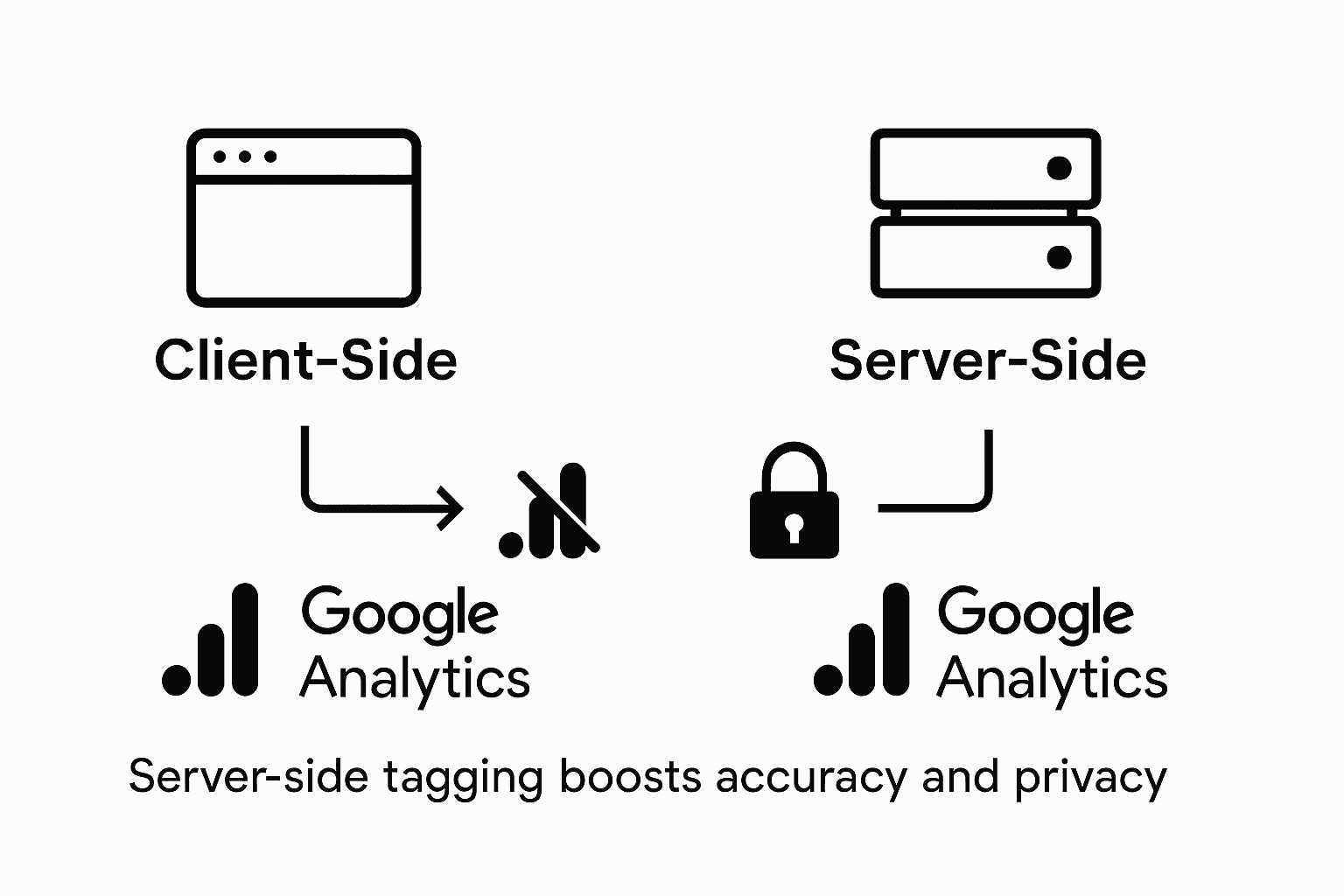
Recent academic research, including a comprehensive study from Radboud University Nijmegen, underscores the significant advantages of advanced privacy-focused tracking methodologies. These approaches not only enhance data protection but also improve overall data quality by providing granular control over information collection, transformation, and transmission processes. Marketing teams can now configure intricate rules that precisely define which data points are captured, how they are processed, and which external services receive specific information.
Pro Privacy Optimisation Tip: Conduct a comprehensive audit of your current data collection practices, identifying and eliminating unnecessary personal data collection points to minimise privacy risks and enhance user trust.
Key Data Privacy Enhancements:
- Automatic removal of sensitive personal identifiers
- Granular control over data transmission
- Enhanced compliance with data protection regulations
- Reduced risk of unintentional data exposure
- Improved transparency in data collection processes
Integrating with E‑commerce Platforms
E-commerce platform integration represents a critical strategy for businesses seeking to leverage comprehensive digital analytics. Tracking sales activity and performance through advanced analytics tools enables organisations to transform raw transactional data into strategic business intelligence.
The integration process typically involves connecting Google Analytics directly with popular e-commerce platforms such as Shopify, WooCommerce, and Magento. This seamless connection allows businesses to automatically capture detailed transaction data, including revenue metrics, product performance, customer purchasing patterns, and conversion funnel insights. By implementing server-side tracking mechanisms, organisations can ensure more reliable data collection that reduces potential tracking gaps and provides a more holistic view of customer interactions.
Advanced e-commerce reporting capabilities enable marketing teams to dive deep into nuanced performance metrics. These sophisticated analytics tools can track complex customer journeys, identifying precise touchpoints that influence purchasing decisions. Detailed reports can reveal crucial insights such as average order value, product popularity, conversion rates across different customer segments, and the effectiveness of marketing campaigns in driving sales.
Pro Integration Tip: Regularly audit and validate your analytics integration settings, ensuring that all critical conversion and transaction data points are being accurately captured and processed.
The following table summarises how integrating analytics with e-commerce platforms benefits business intelligence:
| Business Insight | Resulting Advantage | Example Metric |
|---|---|---|
| Transaction analysis | Informs product strategy | Average order value |
| Customer journey mapping | Reveals conversion opportunities | Funnel drop-off rate |
| Marketing effectiveness | Enables targeted campaigns | Campaign-attributed sales |
| Product performance review | Supports inventory and pricing decisions | Best-selling items |
Key E-commerce Integration Benefits:
- Comprehensive sales performance tracking
- Detailed customer behaviour insights
- Automatic transaction data collection
- Enhanced marketing strategy development
- Precise conversion rate analysis
Risks, Complexities and Maintenance
Server-side tracking technologies introduce a complex landscape of technical challenges that organisations must carefully navigate. Technical implementation complexities require businesses to develop sophisticated infrastructure and maintain rigorous operational standards to ensure effective data management.
The primary challenges revolve around establishing and maintaining a robust server environment capable of handling sophisticated data processing tasks. This involves significant investments in technical infrastructure, including secure server configurations, advanced data routing mechanisms, and comprehensive monitoring systems. Organisations must develop specialised technical expertise to manage these intricate tracking systems, which often requires dedicated personnel with advanced skills in data engineering, cybersecurity, and analytics platform management.
Further complications emerge from the ongoing maintenance and compliance requirements associated with server-side tracking technologies. Businesses must continuously update their systems to address emerging security vulnerabilities, adapt to changing data protection regulations, and ensure seamless integration with evolving digital marketing platforms. These persistent demands can strain organisational resources and require a commitment to continuous learning and technological adaptation.
Pro Maintenance Tip: Develop a comprehensive technology roadmap that anticipates potential infrastructure challenges and allocates dedicated resources for ongoing system updates and skill development.
Key Potential Risks and Challenges:
- Significant technical infrastructure requirements
- High initial and ongoing implementation costs
- Complex data security management
- Continuous compliance monitoring
- Need for specialised technical expertise
Boost Your Conversion Credibility with Precise Server‑Side Tagging
Many businesses struggle with incomplete or inaccurate conversion tracking that leads to poor marketing decisions and missed revenue opportunities. As this article highlights, data accuracy, privacy compliance, and comprehensive user behaviour insights are essential for optimising your e-commerce performance. Implementing server‑side tagging is key to overcoming challenges such as data loss, privacy risks, and slow website performance, all while ensuring you capture 100% of your conversions reliably.

Take control of your analytics today with AdPage, the platform dedicated to enhancing conversion tracking through advanced server‑side tagging solutions. Our tools help marketing agencies and online marketers eliminate tracking gaps, maintain GDPR compliance, and gain detailed conversion intelligence with seamless integration for Shopify, WooCommerce, and Magento. Start transforming your e-commerce data into actionable growth strategies. Visit AdPage now to unlock the full potential of your digital analytics and never miss a conversion again.
Frequently Asked Questions
What are the main benefits of using Google Analytics for conversion tracking?
Google Analytics provides detailed insights into user behaviour, demographics, and traffic sources, which helps businesses understand their audience and optimise their marketing strategies to boost conversions.
How does server-side tagging enhance data accuracy in Google Analytics?
Server-side tagging centralises data collection in a secure environment, reducing the risk of data loss from ad blockers and increasing the accuracy of tracking by filtering and validating data before it is sent to third-party platforms.
What types of metrics can I track with Google Analytics?
You can track various metrics including page views, session duration, bounce rates, conversion pathways, average order value, and customer journey touchpoints, providing a comprehensive view of website performance and user engagement.
How do I ensure compliance with data protection regulations when using Google Analytics?
To ensure compliance, implement server-side tagging and configure granular data collection rules, automatically anonymise sensitive information, and regularly review your data practices to align with the latest regulations.