


.png)

Most british e-commerce marketers underestimate how server-side tagging can transform analytics. With over 40 percent of retail sites still vulnerable to client-side data loss and privacy issues, staying ahead demands stronger solutions. This introduction uncovers how switching to server-side Google Tag Manager empowers global agencies to capture more accurate conversion data, strengthen compliance strategies, and outpace browser privacy restrictions that plague traditional tracking methods.
Table of Contents
- Gtm Server Side: Concepts And Misconceptions
- Comparing Client And Server Side Tagging Methods
- Key Features And Benefits For E-Commerce Sites
- Integrating Gtm Server Side With Common Platforms
- Managing Privacy, Compliance, And Consent
- Common Implementation Mistakes And How To Avoid Them
Key Takeaways
| Point | Details |
|---|---|
| Server-Side GTM Enhances Data Management | Transitioning to server-side Google Tag Manager improves data privacy, reduces page load times, and enhances tracking accuracy. |
| Complexity Misconceptions Addressed | While server-side setup requires a more sophisticated configuration, modern tools simplify the process for marketers. |
| Integration Strategy is Crucial | Successful implementation necessitates detailed planning and understanding of platform-specific tracking requirements. |
| Prioritise Consent Management | Advanced consent handling is essential to ensure compliance with regional regulations, respecting user preferences in data processing. |
GTM server side: concepts and misconceptions
Server-side Google Tag Manager (GTM) represents a significant shift in digital tracking methodology, moving beyond traditional client-side approaches. Server-side processing fundamentally transforms how websites collect, manage, and distribute user data, offering marketing professionals enhanced control and precision in analytics tracking.
Traditional client-side tracking relies on browser-executed javascript, which creates multiple vulnerabilities. Server-side GTM circumvents these limitations by transferring data processing responsibilities to dedicated server environments. This approach provides several critical advantages: improved data privacy, reduced page load times, enhanced tracking accuracy, and superior protection against ad-blockers and browser privacy restrictions.
Common misconceptions about server-side GTM often revolve around implementation complexity and perceived technical barriers. While the setup does require more sophisticated configuration compared to client-side tracking, modern platforms have significantly simplified the process. Marketers need not become expert developers to leverage these advanced tracking capabilities. Instead, they can focus on strategic data interpretation and campaign optimisation.
Pro Tip - Server Configuration: Carefully map your data collection requirements before implementing server-side GTM, ensuring you understand precisely which user interactions and conversion points need tracking for your specific e-commerce ecosystem.
Comparing client and server side tagging methods
E-commerce tracking technologies have evolved significantly, with client-side and server-side tagging representing two distinct methodologies for data collection. Server-side tagging advantages reveal fundamental differences in how digital tracking mechanisms operate, fundamentally transforming data privacy and performance strategies.
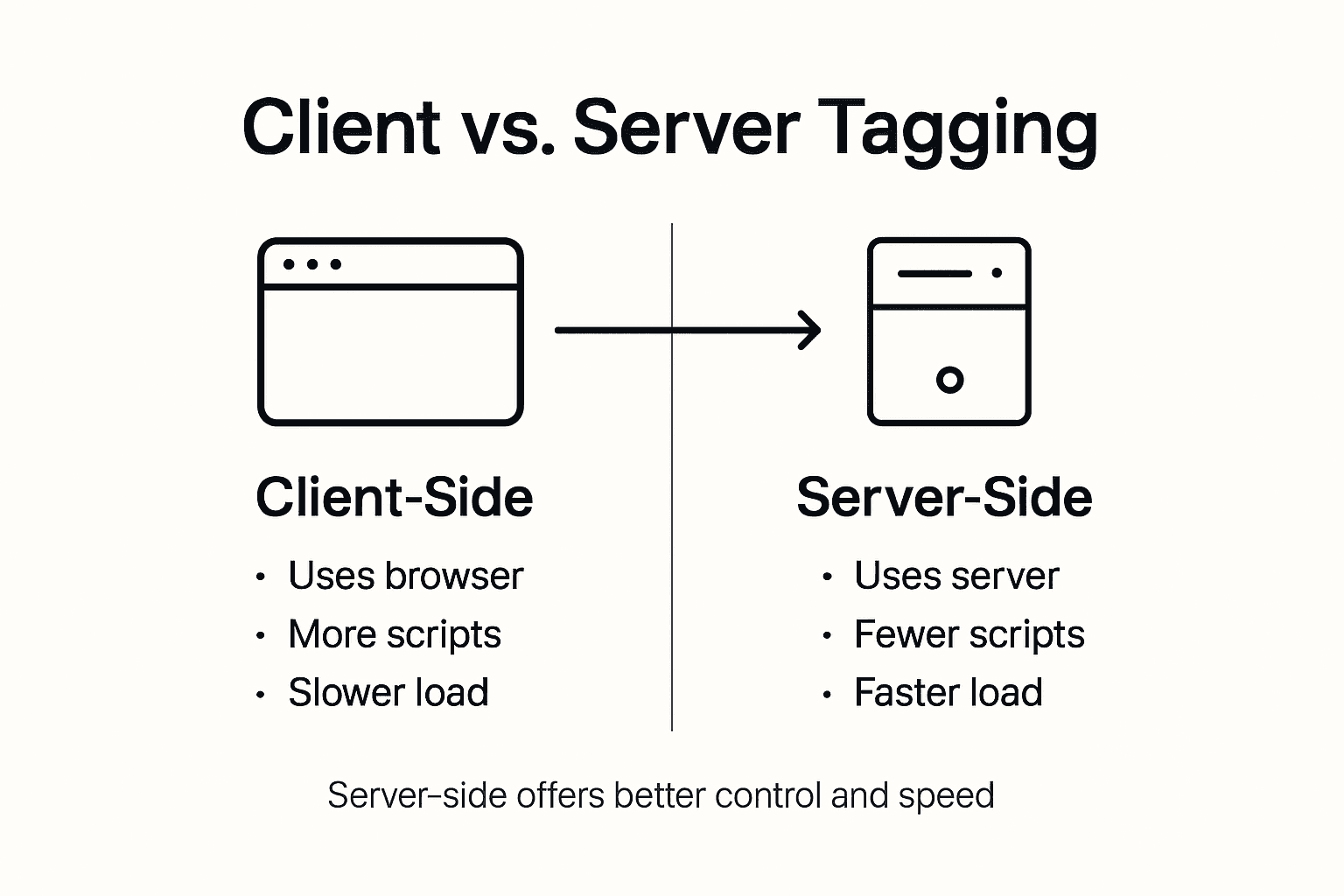
Client-side tagging traditionally executes tracking scripts directly within the user’s web browser, relying on javascript to capture and transmit user interaction data. This method introduces several inherent limitations: increased page load times, vulnerability to ad-blockers, potential data loss, and reduced privacy protection. Each tracking script adds computational overhead, potentially degrading website performance and user experience.
Server-side tagging shifts data processing away from the client’s browser to dedicated server infrastructure, offering a more robust and controlled tracking environment. By centralising data collection and processing, marketers gain enhanced capabilities for managing tracking protocols, reducing dependency on individual browser technologies. This approach provides superior data integrity, improved load speeds, and greater flexibility in handling complex tracking requirements across multiple platforms and devices.
Pro Tip - Tracking Strategy: Conduct a comprehensive audit of your current tracking implementation, identifying potential performance bottlenecks and privacy vulnerabilities before transitioning between client and server-side tracking methodologies.
Here is a comparison of key differences between client-side and server-side tagging:
| Aspect | Client-Side Tagging | Server-Side Tagging |
|---|---|---|
| Data Processing Location | User’s browser | Dedicated server |
| Vulnerability to Ad-Blockers | High risk of blocking | Much lower exposure |
| Impact on Page Speed | Can slow load times | Improves page performance |
| Data Privacy Control | Limited by browser | Enhanced, centralised control |
| Tracking Accuracy | Susceptible to loss | Reliable event collection |
Key features and benefits for e-commerce sites
Server-side Google Tag Manager (GTM) delivers transformative capabilities for e-commerce platforms, fundamentally reshaping data tracking strategies through advanced technological approaches. Data accuracy and privacy protection emerge as primary advantages, enabling marketers to capture comprehensive user interaction data while maintaining stringent compliance standards.

Key features of server-side GTM for e-commerce sites include enhanced data processing capabilities, improved tracking reliability, and sophisticated privacy controls. By centralising data collection on dedicated server infrastructure, businesses can mitigate traditional tracking challenges such as cookie limitations, browser restrictions, and potential data loss. This approach allows for more nuanced user journey mapping, enabling marketers to create more personalised and targeted marketing strategies that respond dynamically to customer behaviours.
The technical advantages extend beyond basic tracking mechanisms. Server-side GTM provides robust data enrichment capabilities, allowing e-commerce platforms to consolidate tracking streams from multiple sources, integrate complex consent management protocols, and future-proof their analytics infrastructure against evolving browser technologies and regulatory landscapes. This comprehensive approach ensures marketing teams can maintain high-quality data insights while respecting increasing consumer privacy expectations.
Pro Tip - Implementation Strategy: Conduct a thorough audit of your current tracking infrastructure before migrating to server-side GTM, identifying potential integration points and developing a phased transition plan that minimises disruption to existing analytics workflows.
Integrating GTM server side with common platforms
Successful server-side Google Tag Manager implementation requires strategic approaches to platform integration, with comprehensive setup instructions providing crucial guidance for e-commerce businesses. Platform compatibility emerges as a critical consideration, demanding meticulous attention to technical configurations and data transfer protocols.
E-commerce platforms like Shopify, WooCommerce, and Magento present unique integration challenges that server-side GTM must navigate. Successful implementation involves establishing secure data pipelines, configuring custom server containers, and ensuring seamless communication between tracking systems and platform-specific APIs. This process requires understanding each platform’s unique tracking requirements, webhook configurations, and data transmission mechanisms.
The integration strategy extends beyond simple data collection, encompassing sophisticated tracking methodologies that respect user privacy and maintain robust data governance. Advanced server-side GTM configurations enable businesses to create sophisticated tracking environments that can consolidate data streams, enrich user information, and provide granular insights across multiple e-commerce ecosystem components. By centralising data processing, organisations can overcome traditional tracking limitations and create more resilient, privacy-compliant analytics infrastructures.
Pro Tip - Integration Planning: Develop a comprehensive mapping document detailing each platform’s specific tracking requirements and potential integration points before initiating your server-side GTM implementation strategy.
Managing privacy, compliance, and consent
Server-side Google Tag Manager introduces sophisticated mechanisms for advanced consent handling, transforming how e-commerce businesses manage user data privacy and regulatory compliance. Consent management has evolved from a simple checkbox to a complex, nuanced system of user control and transparent data processing.
The technical architecture of server-side GTM enables granular consent controls that adapt to regional regulatory requirements such as GDPR and CCPA. By implementing intelligent consent modes, businesses can dynamically adjust data collection practices based on explicit user permissions. This approach allows for selective data transmission, ensuring that only approved tracking events are processed and stored, thereby maintaining a robust privacy framework that respects individual user preferences.
Regional variations in privacy regulations demand flexible consent management strategies. Server-side GTM provides comprehensive tools for configuring region-specific consent settings, enabling businesses to create sophisticated consent workflows that automatically adjust tracking behaviour. These advanced configurations allow for precise control over data collection, ensuring that user choices are immediately reflected in tracking mechanisms and that potential compliance violations are proactively prevented.
Pro Tip - Consent Configuration: Develop a comprehensive consent mapping document that details specific user interaction scenarios, tracking limitations, and region-specific privacy requirements before implementing your server-side GTM consent management strategy.
Common implementation mistakes and how to avoid them
E-commerce professionals frequently encounter significant challenges when implementing server-side Google Tag Manager, with common implementation errors potentially undermining tracking accuracy and data integrity. Configuration complexity demands meticulous attention to technical nuances that can dramatically impact analytics performance.
Critical mistakes often stem from inadequate planning and poor understanding of server-side tagging architecture. Common pitfalls include misconfigured triggers, inconsistent naming conventions, insufficient version control, and neglecting comprehensive testing protocols. E-commerce tracking requires precise event mapping, ensuring that every user interaction is captured accurately without compromising site performance or creating unnecessary computational overhead.
Successful server-side GTM implementation necessitates a strategic approach that prioritises comprehensive testing, robust consent management, and granular configuration controls. Marketing teams must develop rigorous validation processes that thoroughly examine tracking mechanisms across different devices, browsers, and user interaction scenarios. This requires creating detailed documentation, implementing multi-stage preview modes, and establishing clear protocols for continuous monitoring and refinement of tracking configurations.
Pro Tip - Implementation Validation: Establish a systematic checklist for server-side GTM deployment that includes comprehensive testing scenarios, consent verification steps, and periodic configuration audits to ensure ongoing tracking reliability.
The following table outlines common server-side GTM implementation errors and solutions:
| Mistake | Impact on Tracking | Prevention Approach |
|---|---|---|
| Misconfigured Triggers | Missed conversions or events | Review trigger logic and test |
| Inconsistent Naming | Data mapping confusion | Adopt clear naming standards |
| Skipping Testing | Unreliable analytics | Implement thorough multi-device tests |
| Poor Consent Management | Compliance risk | Use granular consent controls |
| Lack of Documentation | Onboarding challenges | Maintain detailed process records |
Take Your E-Commerce Tracking to the Next Level with Server-Side GTM
The article highlights the critical challenges e-commerce businesses face with traditional client-side tracking such as data loss, ad-blocker interference, and privacy compliance complexities. If you want precise data accuracy, enhanced consent management, and foolproof tracking reliability, embracing server-side Google Tag Manager is essential. Avoid common implementation mistakes and overcome technical hurdles with a solution designed specifically to optimise your conversion tracking efforts.

Discover how AdPage provides powerful server-side tagging tools tailored for marketing agencies and online marketers looking to improve conversion rates by capturing 100% of user data with confidence. Our platform offers seamless integration with major e-commerce platforms like Shopify and WooCommerce, comprehensive consent management aligned with GDPR, plus in-depth reporting and visitor identity services. Don’t let tracking inaccuracies hold your business back. Take control now with server-side tagging solutions that transform your data into actionable growth insights.
Frequently Asked Questions
What are the main advantages of using server-side GTM for e-commerce tracking?
Server-side GTM enhances e-commerce tracking by improving data accuracy, reducing page load times, providing better data privacy control, and offering more reliable tracking that is less susceptible to ad-blockers.
How does server-side tagging differ from client-side tagging?
Server-side tagging processes data on a dedicated server instead of the user’s browser, leading to superior performance, enhanced privacy controls, and improved tracking accuracy compared to client-side tagging methods.
What common mistakes should be avoided when implementing server-side GTM?
Common mistakes include misconfigured triggers, inconsistent naming conventions, neglecting thorough testing, and inadequate consent management, all of which can undermine tracking accuracy and data integrity.
How does server-side GTM manage user consent and privacy compliance?
Server-side GTM utilises advanced consent handling mechanisms that adjust data collection based on user permissions, ensuring compliance with privacy regulations like GDPR and CCPA while allowing for flexible consent management strategies.