


.png)

Most advice about digital analytics still overlooks the impact of server‑side tagging on privacy, accuracy, and data control. As stricter regulations reshape how British businesses handle user information, the demand for reliable solutions has soared. In fact, more than 60 percent of marketers are rethinking their current tracking setup to meet these new standards. Discover how server‑side tagging can give you greater confidence in your data while protecting your users’ privacy and improving website speed.
Table of Contents
- What Server‑Side Tagging Means
- How Server‑Side GTM Works
- Variants And Deployment Options
- Performance, Privacy And Data Control
- Setup Requirements And Best Practices
- Risks, Costs And Pitfalls
Key Takeaways
| Point | Details |
|---|---|
| Enhanced Data Control | Server-side tagging centralises data processing, providing organisations with greater control over how tracking data is collected and sent to various platforms. |
| Improved Privacy Compliance | This approach enhances user privacy by allowing more granular management of sensitive information and better compliance with data regulations. |
| Optimised Performance | By shifting processing away from client devices, server-side tagging reduces the load on user browsers, leading to faster web page performance. |
| Flexible Deployment Options | Businesses can choose deployment strategies from cloud-based solutions to on-premises setups, ensuring alignment with their specific technical and operational needs. |
What Server‑Side Tagging Means
Server‑side tagging represents a sophisticated approach to digital tracking that fundamentally shifts how web analytics and marketing data are collected and processed. Unlike traditional client‑side tracking methods which execute directly in a user’s browser, server‑side tracking moves critical data processing functions to a secure backend server environment. This strategic transition offers substantial improvements in data accuracy, privacy protection, and overall tracking performance.
At its core, server‑side tagging enables organisations to process tracking information through a dedicated server infrastructure before transmitting specific data points to analytics platforms. By intercepting and filtering tracking requests before they reach the client’s browser, businesses gain unprecedented control over data collection workflows. This approach mitigates several persistent challenges associated with traditional tracking techniques, such as potential data loss from ad blockers, browser privacy restrictions, and incomplete conversion tracking.
The technical mechanism behind server‑side tagging involves establishing a middleware layer that acts as an intelligent routing system for digital events. When a user interacts with a website, instead of immediately sending raw tracking data directly from their browser, the interaction is first sent to your organisation’s server. This centralised server then evaluates, transforms, and selectively forwards relevant information to different marketing and analytics platforms. Such an architecture provides multiple strategic advantages:
- Enhanced data privacy and compliance with stringent regulations
- Reduced performance overhead on user devices
- Greater resilience against tracking prevention technologies
- More accurate and comprehensive conversion tracking
- Simplified management of multiple tracking pixels and tags
By implementing server‑side tagging, digital marketing professionals can create more robust, reliable, and privacy‑conscious tracking infrastructures that adapt to the increasingly complex digital ecosystem.
How Server‑Side GTM Works
Google Tag Manager (GTM) server‑side implementation transforms traditional tracking by relocating tag processing from the client’s browser to a secure, controlled server environment. This sophisticated approach enables more precise tracking mechanisms that provide unprecedented control over data collection and transmission workflows.
The operational process begins when a user interacts with a website, triggering an initial event. Instead of immediately executing tracking scripts in the browser, this event is securely transmitted to a dedicated server running GTM’s server‑side container. This centralised server then becomes an intelligent routing hub, capable of processing, filtering, and transforming tracking data before redistributing it to various analytics platforms, marketing tools, and data warehouses.
Within the server‑side GTM architecture, several critical processing stages occur:
- Event Capture: Initial user interactions are captured without immediate browser‑side execution
- Data Transformation: Raw event data is sanitised, enriched, and restructured
- Destination Routing: Processed information is strategically sent to specific analytics platforms
- Privacy Filtering: Sensitive user information can be anonymised or selectively removed
- Performance Optimisation: Reduces computational load on user devices
By implementing server‑side GTM, organisations gain a robust mechanism for managing complex tracking requirements while maintaining superior data integrity, performance, and user privacy. This approach represents a quantum leap in digital analytics, providing marketers and technical teams with granular control over their data ecosystem.
Variants And Deployment Options
Server‑side tagging deployment presents multiple strategic approaches, each offering unique advantages for organisations seeking flexible tracking infrastructure. Deployment options range from automated Google Cloud Run implementations to manual Docker-based configurations, enabling businesses to select an approach that aligns perfectly with their technical environment and operational requirements.

The primary deployment variants can be categorised into three distinct architectural models. The first involves direct utilisation of Google Cloud Platform, which provides seamless integration and minimal configuration overhead. This approach is particularly suitable for organisations already leveraging Google’s ecosystem. The second model enables deployment across alternative cloud infrastructure providers, offering greater flexibility for enterprises with existing cloud investments. The third variant involves on‑premises server configurations, which can provide enhanced data sovereignty and compliance for organisations with stringent security protocols.
Key deployment considerations include:
- Platform Compatibility: Ability to integrate with existing cloud or local infrastructure
- Scalability: Potential to handle varying traffic volumes and computational demands
- Performance: Minimal latency and efficient data processing capabilities
- Security: Robust data protection and access control mechanisms
- Cost Efficiency: Optimised resource utilisation and infrastructure expenses
Custom domain configurations offer additional advantages, enabling organisations to enhance cookie privacy, manage server requests more effectively, and create more sophisticated tracking environments. By selecting an appropriate deployment strategy, businesses can transform their digital analytics infrastructure, achieving unprecedented levels of data control, privacy protection, and insights generation.
Performance, Privacy And Data Control
Server‑side tagging represents a transformative approach to digital tracking that simultaneously enhances website performance, data quality, and privacy controls. By shifting critical data processing functions from client‑side browsers to secure server environments, organisations can achieve a sophisticated balance between comprehensive analytics and user privacy protection.
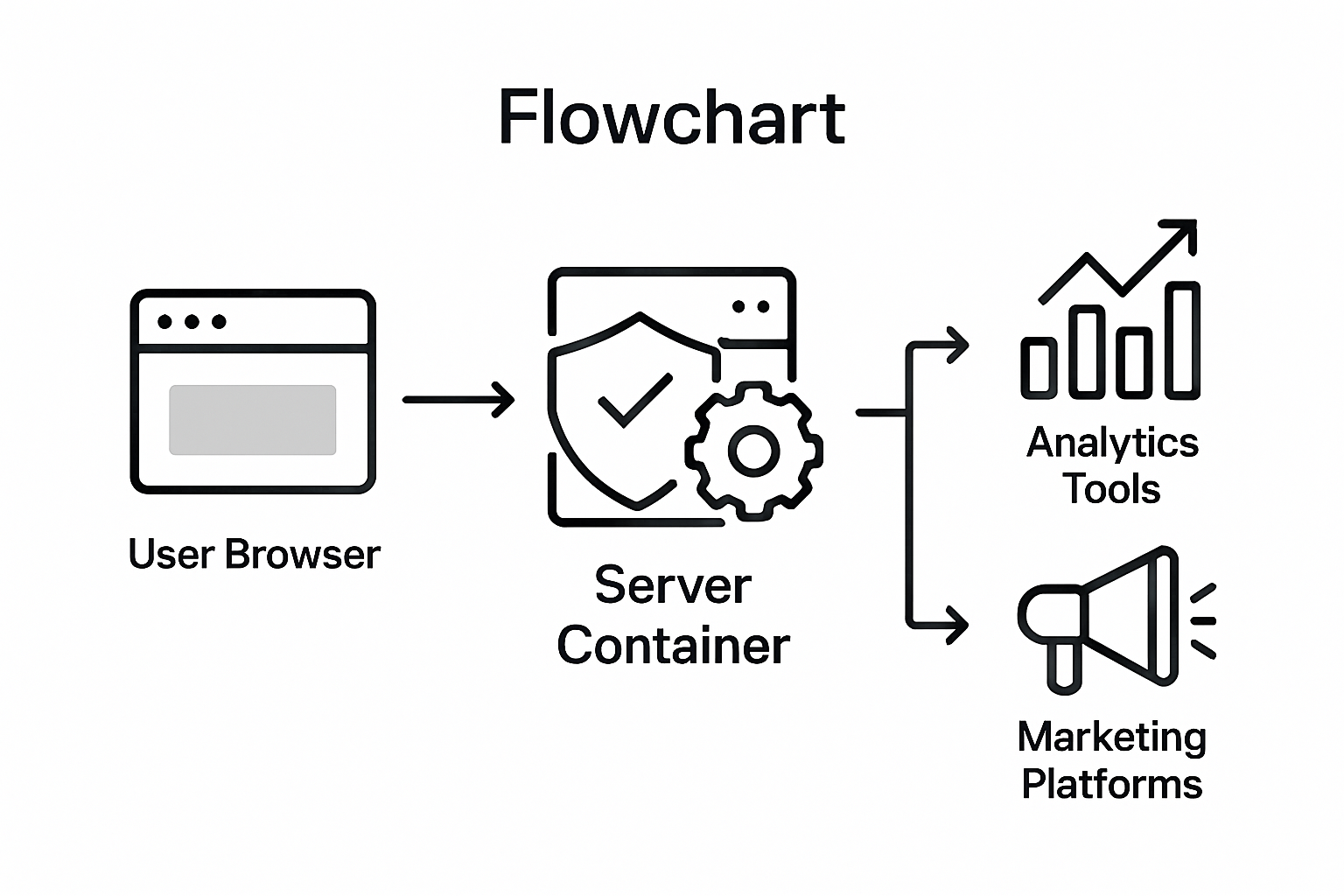
The performance implications of server‑side tagging are particularly significant. Traditional client‑side tracking methods burden user devices with multiple script executions, potentially slowing page load times and degrading user experience. In contrast, server‑side implementations centralise data processing, dramatically reducing computational overhead on individual browsers. This architectural shift means fewer resources are consumed during page rendering, resulting in faster, more responsive web experiences that maintain comprehensive tracking capabilities.
Key advantages of server‑side tracking encompass multiple critical dimensions:
- Reduced Browser Load: Minimises client‑side script execution
- Enhanced Data Accuracy: Provides more reliable tracking information
- Improved Privacy Controls: Enables granular management of user data
- Vendor Data Filtering: Allows selective transmission of tracking information
- Compliance Management: Supports more robust data protection strategies
Careful configuration remains essential to maintaining optimal performance, as improper implementation can potentially introduce new computational bottlenecks. Organisations must strategically balance their tracking requirements with performance considerations, ensuring that server‑side tagging delivers genuine improvements rather than creating additional complexity. By adopting a thoughtful, measured approach to implementation, businesses can unlock unprecedented levels of tracking precision while respecting user privacy and maintaining superior digital experiences.
Setup Requirements And Best Practices
Implementing server‑side tagging requires a strategic approach that balances technical complexity with operational efficiency. Configuring server containers involves multiple critical steps, including precise environment variable management and potential service account credential setup, demanding a methodical and nuanced implementation strategy.
The foundational setup process encompasses several key technical considerations. Organisations must first establish a robust server infrastructure capable of handling data processing demands, whether through cloud platforms or dedicated on‑premises solutions. This involves selecting appropriate computational resources, configuring network security parameters, and ensuring scalable data routing mechanisms. Successful implementation requires deep understanding of both technical infrastructure and tracking ecosystem requirements.
Critical setup and configuration best practices include:
- Separate Container Management: Create distinct containers for different digital properties
- Version Control: Implement meaningful container versioning for streamlined debugging
- Performance Monitoring: Continuously track container size and processing efficiency
- Security Configuration: Establish granular access controls and authentication protocols
- Compliance Alignment: Ensure tracking mechanisms meet regulatory data protection standards
Systematic container management and thoughtful configuration are paramount to maintaining optimal performance, with organisations needing to balance technical sophistication against potential computational overhead. By adopting a meticulous, incremental approach to server‑side tagging deployment, businesses can transform their digital tracking capabilities while maintaining robust performance and data integrity standards.
Risks, Costs And Pitfalls
Server‑side tagging, while offering substantial strategic advantages, introduces a complex landscape of potential risks and financial considerations that organisations must carefully navigate. The implementation involves nuanced cost structures and potential performance challenges depending on usage and project configurations, requiring a sophisticated approach to risk management and resource allocation.
Financial implications extend beyond initial setup, encompassing ongoing infrastructure maintenance, computational resources, and potential scaling expenses. Cloud‑based server‑side tagging solutions typically operate on consumption‑based pricing models, meaning organisations pay proportionally to their data processing volume. This dynamic pricing structure can lead to unpredictable monthly expenditures, particularly for businesses experiencing rapid growth or significant traffic fluctuations. Additional hidden costs may emerge from required technical expertise, potential consulting services, and necessary infrastructure upgrades.
Key risks and potential pitfalls include:
- Computational Overhead: Increased server processing requirements
- Configuration Complexity: Intricate setup and maintenance challenges
- Performance Variability: Potential latency and response time fluctuations
- Data Integrity Risks: Potential for incomplete or misconfigured tracking
- Compliance Vulnerabilities: Complex data protection implementation
Continuous monitoring and proactive management are essential to mitigate potential operational risks, ensuring that server‑side tagging delivers genuine value without compromising user experience or organisational efficiency. Successful implementation demands a strategic, incremental approach that balances technological innovation with pragmatic risk assessment.
Take Full Control of Your Tracking with Server‑Side Solutions
The challenge of inaccurate tracking and data loss in traditional client‑side methods is a significant hurdle for e-commerce businesses aiming for precise conversion insights. This article highlights how Google Tag Manager server‑side tagging can overcome issues like ad blocker interference, browser privacy restrictions, and incomplete conversion data with enhanced control and privacy compliance. If you are looking to boost tracking accuracy while reducing browser load and safeguarding user privacy, implementing a robust server‑side tagging solution is essential.

Discover how AdPage empowers marketing teams and agencies to optimise their digital tracking infrastructure effortlessly. Our platform offers seamless server‑side tagging tools that fully integrate with popular e-commerce platforms such as Shopify, WooCommerce, and Magento. Benefit from 100% conversion monitoring, GDPR-compliant consent management, and advanced visitor identity features. Take the step now towards improved data integrity and maximised marketing performance by choosing AdPage. Learn more and get started today.
Frequently Asked Questions
What is server-side tagging in Google Tag Manager?
Server-side tagging in Google Tag Manager refers to the process of moving tracking data processing from the user’s browser to a secure server environment. This enhances control over data collection and improves tracking accuracy and user privacy.
How does server-side GTM improve tracking accuracy?
Server-side GTM improves tracking accuracy by processing data in a centralised server rather than in the browser. This reduces the impact of ad blockers and browser restrictions, enabling more reliable conversion tracking and data collection.
What are the main benefits of using server-side tagging?
The main benefits of server-side tagging include enhanced data privacy, reduced performance load on user devices, improved data accuracy, better compliance with regulations, and greater control over tracking workflows.
What are the potential challenges when implementing server-side tagging?
Potential challenges include configuration complexity, increased server costs based on data processing, risks of latency in response times, and the necessity for careful management to avoid misconfigured tracking that could compromise data integrity.