


.png)

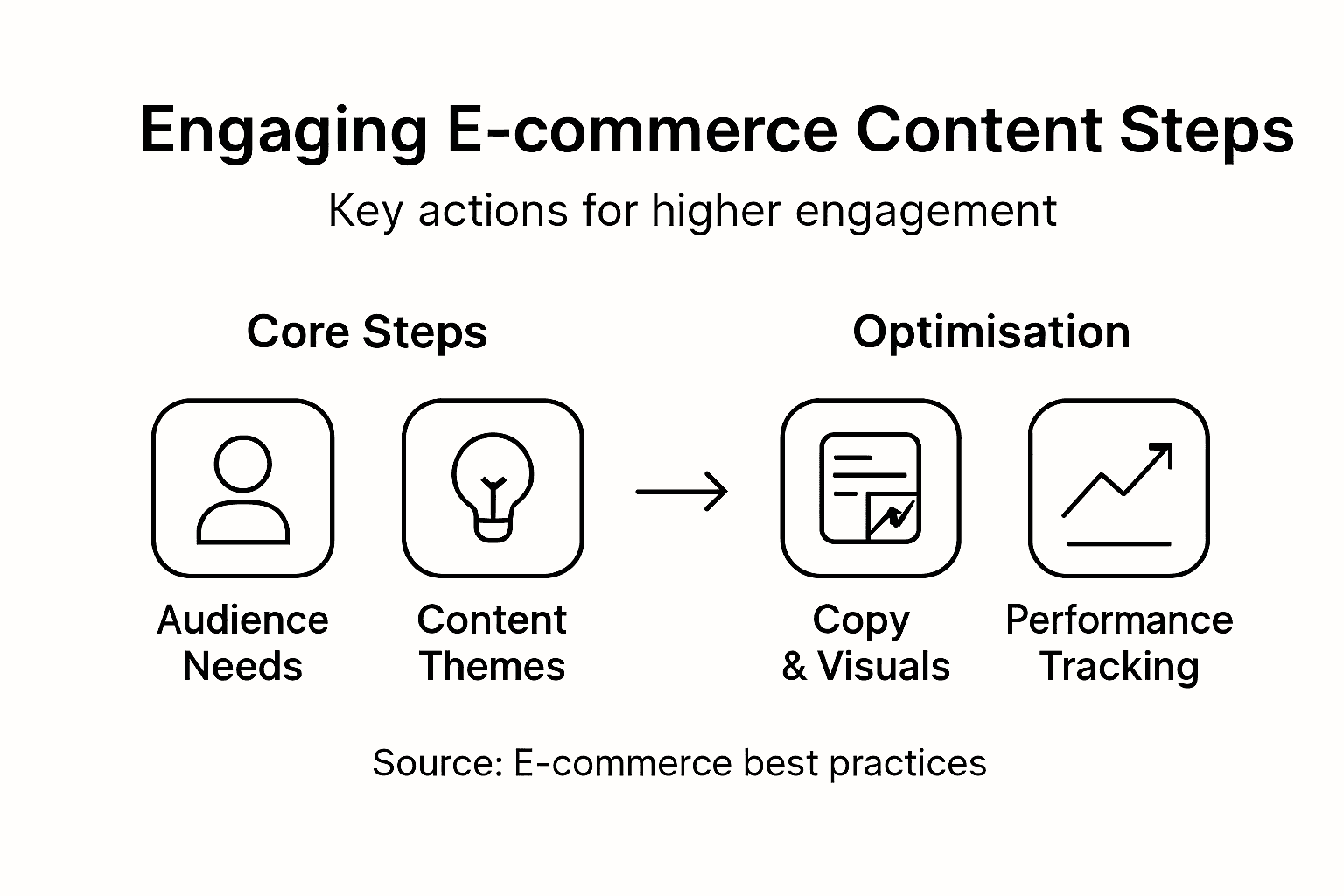
Finding meaningful connections between customer behaviour and business growth can be challenging for E-commerce marketing managers. With more data than ever pouring in from platforms like Shopify and WooCommerce, the real challenge is making sense of it all while prioritising privacy and compliance. This guide brings together principles of data-driven audience research and actionable content strategies, equipping you to build campaigns that resonate and deliver measurable results.
Table of Contents
- Step 1: Identify Audience Needs And Data Insights
- Step 2: Craft Compelling And Relevant Content Themes
- Step 3: Optimise Copy And Visuals For Engagement
- Step 4: Implement Tracking For Content Performance
- Step 5: Verify Results And Refine Your Approach
Quick Summary
| Key Point | Explanation |
|---|---|
| 1. Understand your audience deeply | Use extensive data collection methods to create detailed customer personas, ensuring a better engagement rate. |
| 2. Develop relevant content themes | Align your content with specific customer needs to increase resonance and improve conversion rates. |
| 3. Optimise copy and visuals | Focus on persuasive writing and strategic visuals that enhance product descriptions and captivate customers. |
| 4. Implement performance tracking | Set measurable KPIs and regular evaluation intervals to refine your e-commerce content strategy effectively. |
| 5. Verify results and refine strategy | Use thorough data assessment and cross-reference metrics to adjust your content strategy based on real insights. |
Step 1: Identify audience needs and data insights
Understanding your e-commerce audience begins with strategic data collection and analysis. By leveraging digital audience research techniques, marketing managers can develop precise customer personas that drive engagement and conversion rates.
Effective audience identification involves multiple research methodologies:
- Conduct comprehensive demographic surveys
- Analyse website traffic and user behaviour patterns
- Review customer interaction data across platforms
- Examine social media engagement metrics
- Study purchase history and browsing behaviours
Successful e-commerce strategies are built on understanding nuanced customer motivations, not just surface-level data points.
To extract meaningful insights, integrate quantitative and qualitative research methods. This approach allows you to move beyond basic demographic information and understand deeper psychological drivers. Audience segmentation research reveals critical information about customer preferences, communication styles, and potential purchasing triggers.
Here’s a summary of how quantitative and qualitative research methods complement each other in audience analysis:
| Research Method | Key Strength | Ideal Use Case | Typical Output |
|---|---|---|---|
| Quantitative | Provides numerical accuracy | Measuring large-scale trends | Statistical reports, charts |
| Qualitative | Explores motivations deeply | Understanding individual behaviours | Interview transcripts, insights |
| Combined Approach | Delivers richer insights | Revealing both trends and motivations | In-depth persona development |
Pro tip: Invest in advanced analytics tools that provide granular insights into customer behaviour and segment your audience with precision.
Step 2: Craft compelling and relevant content themes
Crafting engaging e-commerce content requires a strategic approach that goes beyond surface-level marketing. By developing thematic content analysis techniques, marketers can create narratives that resonate deeply with their target audience’s motivations and needs.
Successful content theme development involves several critical strategies:
- Identify core audience pain points and aspirations
- Align content themes with specific customer segments
- Create narratives that solve real customer challenges
- Develop emotional and rational connection points
- Use data-driven insights to validate content relevance
Compelling content themes transform product information into meaningful customer experiences.
To ensure your content themes are truly impactful, research-driven conceptual contributions must underpin your strategy. This means moving beyond generic storytelling and constructing narratives that provide genuine value, demonstrate expertise, and directly address customer needs.

This table outlines core content theme strategies and their business impact:
| Content Strategy | Customer Benefit | Business Impact |
|---|---|---|
| Addressing audience pain points | Builds trust and relevance | Increases conversion rates |
| Aligning with audience segments | Delivers tailored experiences | Improves targeting accuracy |
| Balancing emotional and rational tones | Enhances engagement | Boosts customer loyalty |
Pro tip: Regularly audit and refresh your content themes to maintain relevance and alignment with evolving customer expectations.
Step 3: Optimise copy and visuals for engagement
Crafting compelling e-commerce content requires a delicate balance between persuasive copywriting and strategic visual design. By implementing visual communication strategies, you can transform mundane product descriptions into engaging narratives that captivate your audience’s attention.
Key strategies for optimising copy and visuals include:
- Create concise, benefit-driven product descriptions
- Use high-quality, contextual imagery
- Implement clear visual hierarchies
- Match visual tone with brand personality
- Ensure visual accessibility across devices
Effective visual communication bridges the gap between product information and emotional connection.
When developing content, focus on compelling visual presentation techniques that simplify complex information. This means selecting images that not only showcase your products but also tell a story, evoke emotion, and provide clear context for potential customers.
Pro tip: Conduct regular A/B testing on your visual and copy combinations to continuously refine engagement metrics and understand what resonates most with your audience.
Step 4: Implement tracking for content performance
Tracking content performance is a critical component of successful e-commerce marketing, requiring systematic measurement and strategic analysis. By implementing robust progress monitoring techniques, you can transform raw data into actionable insights that drive continuous improvement.
Key tracking strategies for e-commerce content performance include:
- Define clear, measurable key performance indicators (KPIs)
- Establish baseline performance metrics
- Implement regular data collection intervals
- Use comprehensive analytics platforms
- Create visual performance dashboards
- Compare performance across different content types
Effective tracking transforms data points into strategic marketing intelligence.
To develop a robust tracking framework, develop balanced performance measurement strategies that align with your specific business objectives. This means moving beyond surface-level metrics to understand the deeper contextual impact of your content across customer engagement lifecycles.
Pro tip: Automate your performance tracking processes and schedule monthly review sessions to ensure consistent, data-driven content refinement.
Step 5: Verify results and refine your approach
Validating the performance of your e-commerce content requires a systematic approach to data interpretation and strategic refinement. By understanding critical source evaluation techniques, you can ensure the reliability and effectiveness of your content strategy.
Key verification and refinement strategies include:
- Cross-reference performance metrics from multiple sources
- Conduct comprehensive data quality assessments
- Identify statistically significant variations
- Segment results by audience demographics
- Validate findings against original business objectives
Rigorous result verification transforms raw data into meaningful strategic insights.
To truly optimise your approach, integrate evidence-based refinement methods that go beyond surface-level analysis. This means developing a continuous feedback loop that allows for nuanced adjustments based on robust, contextualised evidence.
Pro tip: Establish a quarterly content performance review process that involves cross-functional team members to gain diverse perspectives on your analytics.
Elevate Your E-commerce Content with Data-Driven Tracking Solutions
Creating engaging content is just the first step to e-commerce success. The real challenge lies in accurately tracking performance and understanding how your audience interacts with your narratives. Without precise conversion tracking and reliable data collection, even the most well-crafted content themes may not deliver the results you expect. Key pain points from the article, such as optimising copy and visuals for engagement and implementing effective tracking, highlight the need for robust tools that capture 100 percent of conversions and provide actionable insights.
AdPage is designed to solve these critical challenges by offering advanced server-side tagging solutions that ensure no data is lost in the tracking process. This empowers marketing agencies and online marketers to monitor genuine user behaviours across channels, refine content strategies based on reliable analytics, and maintain full compliance with GDPR regulations. With seamless integration options for platforms like Shopify and WooCommerce, AdPage helps you transform content engagement into measurable business growth.
Experience the difference precise data can make in creating truly tailored e-commerce experiences that resonate and convert. Discover how AdPage supports your content goals by visiting AdPage and start optimising your conversion tracking today.
Ready to turn your audience insights into winning results with reliable data? Explore the power of AdPage’s server-side tagging services and take the first step towards mastering your e-commerce content performance.
Frequently Asked Questions
How can I identify my e-commerce audience’s needs?
To identify your e-commerce audience’s needs, conduct comprehensive demographic surveys and analyse website traffic data. Use this information to develop customer personas that reflect your audience’s motivations and preferences.
What are effective strategies for creating engaging content themes?
Effective strategies for creating engaging content themes include addressing core audience pain points and aligning content with specific customer segments. Regularly audit your content to ensure it remains relevant and solves real challenges faced by your customers.
How should I optimise my product descriptions for better engagement?
To optimise your product descriptions for better engagement, focus on creating concise, benefit-driven narratives and use high-quality images. Ensure that your visuals complement the text and clearly communicate the value of your products within 30 days.
What key performance indicators (KPIs) should I track for my content?
You should track KPIs such as customer engagement rates, conversion rates, and content reach to measure your content’s performance. Define clear metrics and establish a baseline to compare against for continuous improvement.
How can I validate the effectiveness of my e-commerce content?
To validate the effectiveness of your e-commerce content, cross-reference performance metrics across multiple sources and identify statistically significant variations. Regularly review these findings to ensure your content strategy aligns with your business objectives.