


.png)

Tracking every sale and sign-up can feel overwhelming when reporting solutions are scattered and privacy regulations are constantly evolving. For Canadian and American marketing managers, defining clear reporting objectives is the starting point for making sense of data and demonstrating return on investment. By focusing on key performance indicators and streamlined data collection, you gain actionable insights while confidently meeting GDPR requirements and supporting better decision-making.
Table of Contents
- Step 1: Define Reporting Objectives And Data Needs
- Step 2: Connect Data Sources And Ensure Compliance
- Step 3: Customise Report Structure And Metrics
- Step 4: Generate And Format The Report
- Step 5: Verify Data Accuracy And Usability
Quick Summary
| Key Insight | Explanation |
|---|---|
| 1. Define Clear Objectives | Establish precise reporting goals aligned with your business strategy using the SMART framework for actionable insights. |
| 2. Integrate Data Sources | Connect various data platforms to create a comprehensive view of marketing performance while ensuring compliance with regulations. |
| 3. Customise Report Structure | Tailor your report’s metrics and layout to communicate effectively with stakeholders, ensuring clarity and understandability. |
| 4. Prioritise Data Visualisation | Use appropriate visual tools like charts to simplify complex data, making insights readily absorbing and useful. |
| 5. Validate Data Integrity | Implement checks and protocols to ensure accuracy and reliability of reports, resulting in trustworthy business intelligence. |
Step 1: Define reporting objectives and data needs
Creating precise conversion tracking reports starts with establishing crystal-clear reporting objectives that align directly with your business goals. Tracking performance indicators requires understanding which metrics matter most to your specific marketing strategy.
To define your reporting objectives effectively, follow these strategic steps:
- Identify key performance indicators relevant to your business
- Map customer journey stages and corresponding conversion points
- Determine specific data points needed for comprehensive analysis
- Select metrics that directly reflect marketing effectiveness
Your objectives must be precise and actionable. This means applying the SMART framework - ensuring each reporting goal is Specific, Measurable, Achievable, Relevant, and Time-bound. By establishing these clear parameters, you transform raw data into meaningful insights that drive strategic decision-making.
The following table summarises the advantages of applying the SMART framework to conversion reporting objectives:
| SMART Aspect | Typical Benefit | Example in Conversion Tracking |
|---|---|---|
| Specific | Clear goal orientation | Target improvement of checkout completions |
| Measurable | Quantified progress tracking | Set goal of 20% increase in sign-ups |
| Achievable | Realistic, actionable targets | Use historical data to set benchmarks |
| Relevant | Alignment with business strategy | Focus only on revenue-generating actions |
| Time-bound | Defined timeframe for assessment | Monitor weekly and monthly conversions |
Effective reporting objectives transform data from mere numbers into powerful business intelligence.
Expert Recommendation: Select 3-5 core metrics that genuinely reflect business performance rather than tracking excessive data points that create unnecessary complexity.
Step 2: Connect data sources and ensure compliance
Integrating multiple data sources is crucial for comprehensive conversion tracking, enabling you to capture a holistic view of your marketing performance. Tracking codes and platform integrations form the backbone of effective data collection and analysis.
To successfully connect data sources and maintain compliance, follow these strategic steps:
- Identify all relevant tracking platforms (Google Analytics, CRM systems)
- Implement secure tracking codes across digital platforms
- Establish consent management protocols
- Configure data integration mechanisms
- Verify data consistency and accuracy
Ensuring regulatory compliance requires careful attention to privacy regulations. This means implementing robust data protection strategies that respect user consent and maintain transparency throughout the data collection process.

Here is how key conversion tracking platforms differ in features and data integration capabilities:
| Platform | Data Integration | Compliance Tools | Reporting Versatility |
|---|---|---|---|
| Google Analytics | Real-time web data feed | Built-in GDPR controls | Advanced custom dashboards |
| CRM Systems | Customer lifecycle data | Consent & user permissions | Lead and sales reports |
| Tableau | Multi-source import | Third-party control add-ons | Highly visual trend charts |
| Power BI | API-driven connections | Encryption & audit support | Interactive visual reports |
Effective data integration balances comprehensive tracking with stringent privacy protection.
Expert Recommendation: Regularly audit your data collection processes to ensure ongoing compliance with evolving privacy regulations and maintain user trust.
Step 3: Customise report structure and metrics
Customising your conversion tracking report demands strategic thinking to transform raw data into meaningful insights. Selecting relevant performance metrics enables you to create a comprehensive narrative that speaks directly to your business objectives.
To build an effective reporting structure, consider these key elements:
- Choose specific conversion metrics aligned with business goals
- Create visual representations like charts and graphs
- Develop clear sections for:
- Objectives
- Data sources
- Methodology
- Key results
- Actionable recommendations
Your report should balance technical detail with digestible insights. This means translating complex data into clear, understandable performance visualisations that help stakeholders quickly grasp the most critical information.
An expertly structured report transforms numbers into strategic intelligence.
Expert Recommendation: Tailor your report’s complexity to your audience, ensuring even non-technical stakeholders can understand the core performance narrative.
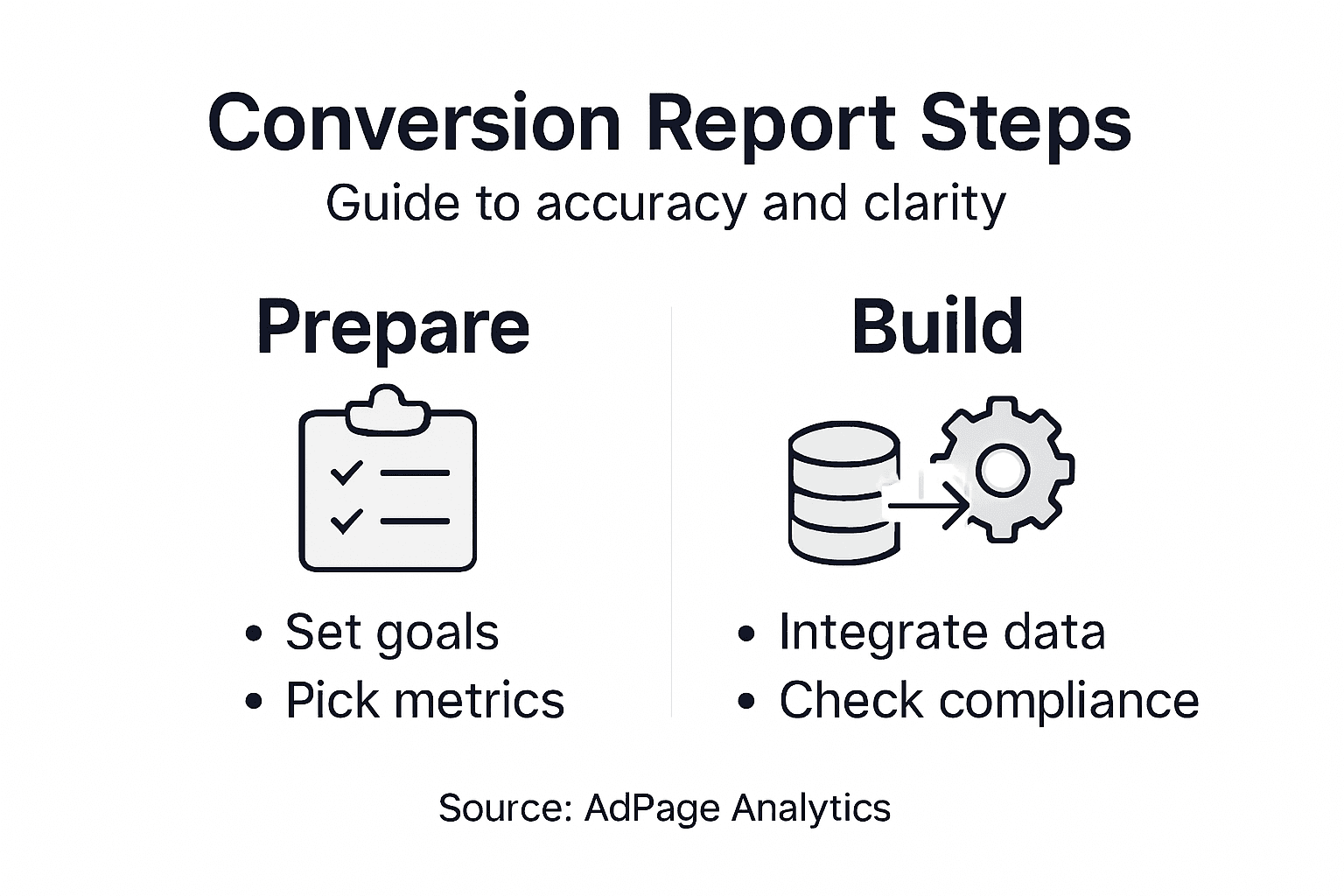
Step 4: Generate and format the report
Transforming your carefully collected conversion data into a compelling report requires strategic planning and powerful visualisation techniques. Data compilation tools and reporting platforms enable you to create insightful, professional-grade reports that communicate complex information effectively.
To generate and format your conversion tracking report, follow these essential steps:
- Select appropriate reporting software (Google Analytics, Power BI, Tableau)
- Compile comprehensive conversion data
- Create visual data representations:
- Line graphs for trend analysis
- Bar charts for comparative metrics
- Pie charts for percentage breakdowns
- Add clear, concise annotations
- Ensure consistent formatting and colour schemes
Your report should tell a cohesive story, transforming raw numbers into meaningful strategic insights. Each visual element should provide clarity, helping stakeholders quickly understand the performance narrative without getting lost in technical details.
An exceptional report translates data points into a compelling business narrative.
Expert Recommendation: Prioritise clarity and simplicity, using visualisations that immediately communicate key performance indicators without overwhelming your audience.
Step 5: Verify data accuracy and usability
Ensuring the reliability of your conversion tracking reports requires meticulous attention to data integrity and comprehensive validation processes. Data validation and integration techniques are crucial for transforming raw information into trustworthy strategic insights.
To verify data accuracy and usability, implement these systematic checks:
- Conduct cross-referencing checks between different data sources
- Establish automated data integrity protocols
- Identify and resolve potential discrepancies
- Standardise data collection methodologies
- Collaborate with IT teams for comprehensive audits
Your verification process should focus on creating transparent reporting mechanisms that stakeholders can trust. This means not just collecting data, but critically examining its reliability, consistency, and relevance to your strategic objectives.
Rigorous data verification transforms potential noise into meaningful business intelligence.
Expert Recommendation: Create a systematic review checklist that allows you to consistently validate data quality and catch potential errors before finalising your reports.
Unlock Accurate Conversion Reporting with Advanced Tracking Solutions
Accurately creating and communicating conversion tracking reports demands clear objectives, reliable data integration, and rigorous validation. The article highlights common challenges such as fragmented data sources, compliance complexities, and the need for precise, actionable insights. If your marketing team struggles with inconsistent tracking data or compliance issues while trying to generate meaningful performance reports, it is time to consider a robust solution that streamlines these processes.
AdPage offers a comprehensive platform designed to solve these exact problems by delivering server-side tagging technology that ensures 100% reliable conversion data capture. With features such as consent management, seamless integration with popular e-commerce platforms like Shopify and WooCommerce, and powerful reporting tools, AdPage empowers marketing agencies and online marketers to own their data confidently while maintaining GDPR compliance. Visit the AdPage landing page to discover how you can enhance your conversion tracking infrastructure today.
Ready to transform your conversion reports from guesswork into definitive business intelligence Take control over your data integrity and performance metrics now by exploring AdPage’s server-side tagging and reporting tools. Visit https://adpage.io/en to get started and ensure your marketing decisions are backed by complete, accurate, and compliant conversion tracking.
Frequently Asked Questions
What are the key metrics I should include in conversion tracking reports?
To enhance your conversion tracking reports, focus on key performance indicators (KPIs) that align with your business goals. Consider selecting 3-5 metrics such as checkout completion rates or sign-up increases, and monitor them consistently to ensure actionable insights.
How do I ensure the accuracy of my conversion tracking data?
To verify the accuracy of your conversion tracking data, conduct cross-referencing checks between different data sources. Establish automated protocols for data integrity and regularly collaborate with IT teams to audit the data collection processes.
What steps should I follow to customise my conversion tracking report?
To customise your conversion tracking report, start by selecting specific conversion metrics that correlate with your business objectives. Organise the report into clear sections, using visual elements like charts to represent the data effectively—this will help convey your performance narrative clearly.
How can I integrate multiple data sources for conversion tracking?
To integrate multiple data sources for conversion tracking, first identify all relevant tracking platforms and ensure secure implementation of tracking codes. Set up data integration mechanisms and regularly verify data consistency to create a comprehensive view of your marketing performance.
What is the SMART framework and how can it improve my reporting objectives?
The SMART framework stands for Specific, Measurable, Achievable, Relevant, and Time-bound objectives. Applying this framework to your reporting goals will help clarify your targets and make it easier to track progress over time—aim for a measurable goal, such as increasing sign-ups by 20% within the next quarter.