


.png)

Safari’s strict limits on third-party cookies have changed how e-commerce marketers monitor customer journeys and measure conversions. Facing privacy demands set by Apple, professionals worldwide now grapple with losing the detailed insights once made possible by cross-site tracking. This article clarifies how Safari’s tracking prevention works, why it disrupts classic attribution models, and what strategies can help digital commerce teams maintain reliable, privacy-conscious analytics in today’s marketplace.
Table of Contents
- Safari 3rd Party Cookies Explained
- How Safari Blocks Third-Party Cookies
- Conversion Tracking Problems for E-Commerce
- Navigating GDPR and Consent Requirements
- Server-Side Tagging and Data Solutions
- Alternatives to Third-Party Cookies in 2026
Key Takeaways
| Point | Details |
|---|---|
| Impact of Safari on Tracking | Safari’s Intelligent Tracking Prevention has aggressively reduced the effectiveness of third-party cookies, drastically changing digital advertising dynamics. |
| Need for Alternative Solutions | E-commerce businesses must develop first-party data strategies and server-side tracking to maintain marketing effectiveness in a stricter privacy landscape. |
| Compliance with GDPR | Under GDPR, e-commerce platforms must ensure transparent user consent processes to protect user privacy while complying with legal requirements. |
| Emerging Technologies | The future of tracking will rely on privacy-preserving technologies such as contextual advertising and server-side tagging to adapt to the evolving data collection landscape. |
Safari 3rd Party Cookies Explained
Third-party cookies represent tracking mechanisms embedded by external domains across websites, enabling sophisticated digital advertising and user behaviour monitoring. Browser privacy policies have fundamentally transformed how these tracking technologies function, with Safari leading significant privacy protection initiatives.
In practical terms, third-party cookies allow advertisers to gather cross-site information about user preferences, browsing patterns, and potential purchasing intent. Apple’s Safari browser has implemented aggressive tracking prevention mechanisms through its Intelligent Tracking Prevention (ITP) framework, systematically restricting these tracking capabilities to protect user privacy.
The technical implementation involves Safari blocking cookies created by domains different from the primary website a user visits. This approach means advertisers can no longer seamlessly track user movements across multiple websites, significantly disrupting traditional digital marketing tracking methodologies. Businesses must now adapt by developing alternative tracking strategies that respect user privacy while maintaining effective marketing insights.
Pro tip: Implement server-side tracking solutions that capture essential user interaction data without relying on traditional third-party cookie mechanisms.
How Safari Blocks Third-Party Cookies
Safari employs a sophisticated Intelligent Tracking Prevention (ITP) mechanism to systematically block third-party cookies, fundamentally transforming digital privacy protection. Cookie blocking settings allow users granular control over how websites track their online activities, effectively preventing cross-site tracking technologies.
The technical approach involves several key strategies. Safari automatically restricts cookies from domains different from the primary website, creating significant barriers for advertisers attempting to track user behaviour across multiple platforms. This means that when a user visits a website, Safari will prevent third-party domains from setting or accessing cookies, effectively breaking traditional cross-site tracking mechanisms.
Moreover, Safari’s ITP goes beyond simple cookie blocking by implementing intelligent machine learning algorithms that dynamically assess website tracking behaviours. These algorithms can identify and neutralise tracking attempts, even when advertisers attempt to use more sophisticated cross-site tracking techniques. By prioritising user privacy, Safari forces digital marketers and web developers to develop more privacy-conscious tracking and advertising strategies.
Pro tip: Investigate server-side tracking alternatives and first-party data collection methods to maintain marketing insights while respecting user privacy boundaries.
Conversion Tracking Problems for E-commerce
E-commerce businesses face significant challenges with conversion tracking as Safari and other browsers increasingly restrict third-party cookie technologies. Empirical research reveals substantial complexities in measuring user interactions and attributing conversions accurately when traditional tracking methods are compromised.

The fundamental issue stems from Safari’s aggressive blocking of cross-site tracking mechanisms. Marketers can no longer rely on comprehensive user journey mapping, which historically allowed precise understanding of how different touchpoints contribute to final purchase decisions. This limitation means e-commerce platforms must develop sophisticated alternative tracking methodologies that respect user privacy while maintaining actionable marketing intelligence.
Additionally, brand marketing studies demonstrate that many organisations struggle to adapt to these new tracking constraints. The reduction in granular audience insights creates significant challenges in targeting, personalisation, and understanding consumer behaviour patterns. E-commerce businesses must now invest in first-party data collection strategies, server-side tracking technologies, and more transparent user consent mechanisms to maintain effective marketing performance.
Pro tip: Develop a comprehensive first-party data strategy that prioritises direct user relationships and transparent data collection practices.
Navigating GDPR and Consent Requirements
E-commerce businesses must carefully manage digital consent requirements under General Data Protection Regulation (GDPR), particularly concerning third-party cookie tracking mechanisms. Legal frameworks surrounding data protection mandate explicit user consent for tracking activities, fundamentally transforming how websites collect and manage user information.
The core challenge involves obtaining genuine, informed consent that meets stringent regulatory standards. Websites must provide clear, transparent explanations about data collection processes, including precise details about which cookies are being used, their purpose, and potential implications for user privacy. This requires implementing robust consent management systems that allow users to granularly control their data sharing preferences, with options to accept, reject, or modify tracking permissions.
Moreover, browser-specific privacy guidelines create additional complexity for e-commerce platforms. Safari’s strict tracking prevention mechanisms, combined with GDPR requirements, demand sophisticated consent management strategies that go beyond traditional cookie consent banners. Businesses must develop dynamic, user-centric approaches that balance regulatory compliance with effective marketing intelligence gathering.
Pro tip: Implement a comprehensive consent management platform that provides transparent, granular user controls and maintains detailed audit trails of user consent interactions.
Server-Side Tagging and Data Solutions
Server-side tagging represents a sophisticated approach to data tracking that circumvents traditional browser-based cookie limitations. Privacy-compliant tracking strategies enable e-commerce businesses to collect and process user data more effectively, shifting critical tracking operations from client-side browsers to secure server environments.
The technical mechanism involves transferring data collection and processing responsibilities away from individual web browsers. This approach allows businesses to maintain comprehensive user tracking and conversion measurement, even when browsers like Safari implement strict privacy restrictions. By routing tracking data through dedicated server infrastructure, companies can create more resilient and privacy-friendly data collection methodologies that preserve marketing intelligence while respecting user consent frameworks.
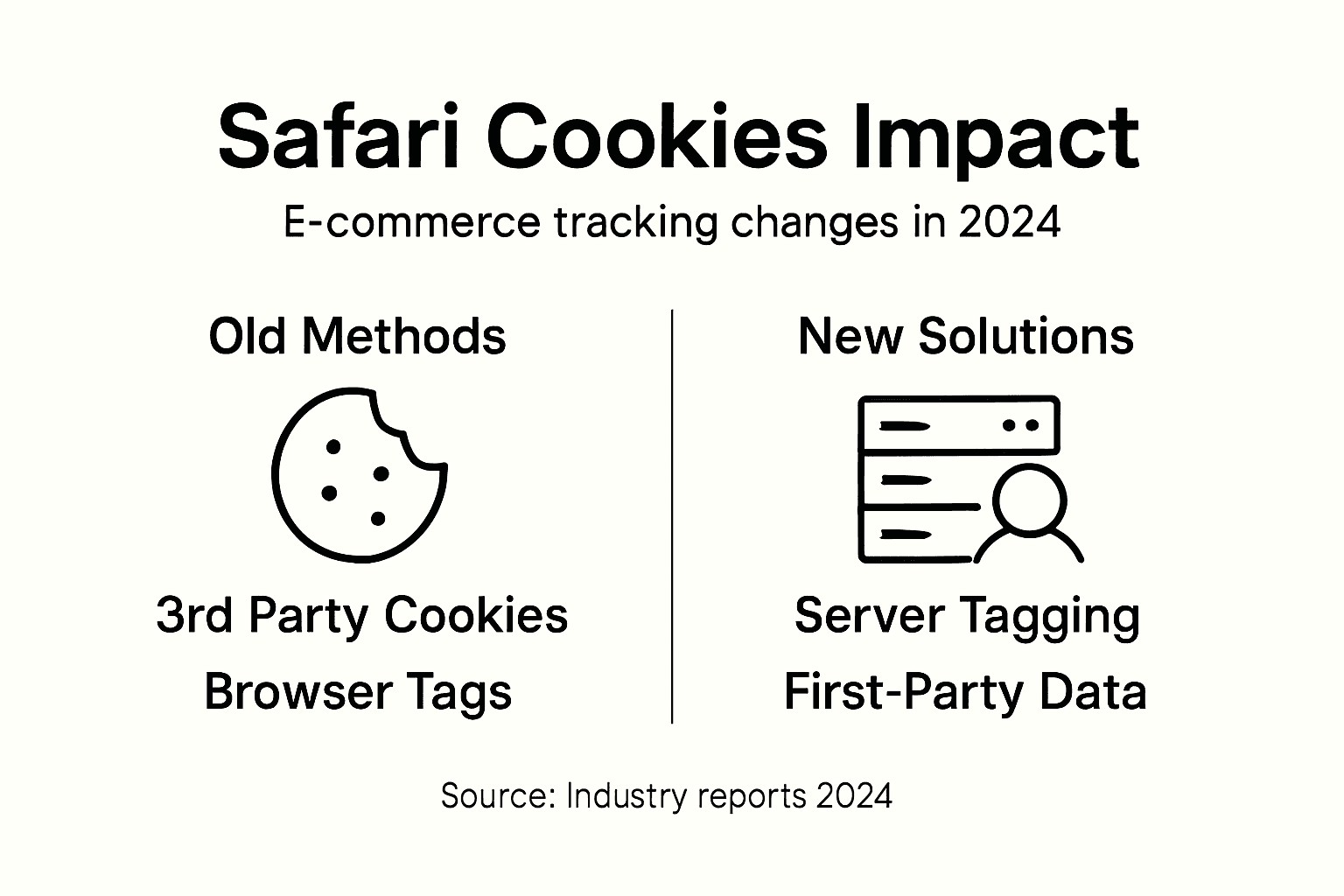
Emerging digital tracking approaches demonstrate that server-side tagging offers multiple strategic advantages. E-commerce platforms can extend customer tracking durations, improve data accuracy, and reduce reliance on third-party cookies that are increasingly vulnerable to browser blocking mechanisms. This method provides a more stable, adaptable solution for maintaining critical marketing insights in an evolving digital privacy landscape.
Here’s a comparison of major tracking solutions available to e-commerce businesses under Safari’s privacy regime:
| Solution Type | Privacy Compliance | Data Accuracy | Technical Complexity |
|---|---|---|---|
| First-party cookies | High, user-controlled | High within single domain | Low, widely supported |
| Third-party cookies | Poor, mostly blocked | Historically high, now limited | Moderate, but increasingly blocked |
| Server-side tagging | Strong with consent | Very high, longer retention | High, requires backend setup |
| Contextual advertising | Strong, no personal data | Moderate, content-based | Moderate, platform dependent |
Pro tip: Invest in robust server-side infrastructure that supports flexible, consent-driven data collection strategies and integrates seamlessly with your existing marketing technology stack.
Alternatives to Third-Party Cookies in 2026
Emerging tracking technologies are rapidly transforming digital marketing strategies, presenting sophisticated alternatives to traditional third-party cookie tracking. E-commerce businesses must adapt to a landscape where privacy-preserving technologies become the primary mechanism for understanding user behaviour and maintaining effective marketing intelligence.
Key alternatives emerging in 2026 include contextual advertising, first-party data strategies, and privacy sandbox initiatives. These approaches enable precise targeting without relying on invasive cross-site tracking mechanisms. Contextual advertising, for instance, focuses on matching ads to webpage content rather than individual user profiles, creating a privacy-friendly alternative that respects user anonymity while maintaining marketing effectiveness.
Global tracking innovation demonstrates multiple promising solutions, including universal IDs, data clean rooms, and advanced server-side tracking technologies. These methods provide granular insights while adhering to stringent privacy regulations, offering e-commerce platforms sophisticated ways to understand customer journeys without compromising individual user privacy. The shift represents a fundamental reimagining of digital marketing’s data collection paradigm.
The following table summarises key challenges and adaptation strategies for e-commerce in a post-third-party cookie environment:
| Challenge | Impact on E-commerce | Adaptation Strategy |
|---|---|---|
| Loss of cross-site tracking | Reduced customer insight | Increase first-party data collection |
| Difficult conversion measurement | Less accurate marketing attribution | Adopt server-side and event-based tracking |
| Stricter GDPR/compliance demands | Greater risk of legal penalties | Deploy transparent consent platforms |
| Limited personalisation | Decreased ad relevance | Shift to contextual ad targeting |
Pro tip: Develop a multi-layered tracking strategy that combines first-party data, contextual targeting, and privacy-compliant technologies to maintain robust marketing insights.
Overcome Safari’s Third-Party Cookie Challenges with Advanced Server-Side Tracking
The growing restrictions Safari places on third-party cookies present real hurdles for e-commerce businesses aiming to maintain accurate conversion tracking and data-driven marketing insights. If you are struggling with data loss, limited user journey visibility, or GDPR compliance complexities highlighted in the article, it is time to explore solutions that fit the evolving privacy landscape.
AdPage offers a powerful platform designed specifically to tackle these challenges. Leveraging server-side tagging technology, AdPage enables you to capture 100% of conversions securely without relying on traditional third-party cookies. Our tools help you stay fully compliant with GDPR while improving data accuracy and maintaining seamless integration with platforms like Shopify, WooCommerce, and Magento. You can also benefit from comprehensive consent management and visitor identity services.

Transform your e-commerce tracking strategy today. Discover how AdPage’s server-side tagging solutions empower you to regain control over your marketing data and turn privacy restrictions into opportunities. Take the first step towards smarter conversion optimisation by visiting AdPage and start onboarding with expert support now.
Frequently Asked Questions
What are third-party cookies and how do they impact e-commerce?
Third-party cookies are tracking mechanisms set by domains other than the website a user is visiting. They allow advertisers to monitor user behaviour across multiple sites, which is crucial for e-commerce in understanding customer preferences and improving targeted marketing.
How does Safari block third-party cookies?
Safari employs Intelligent Tracking Prevention (ITP) to block third-party cookies. This system restricts cookies from domains that differ from the primary site, hindering advertisers’ ability to track users across various platforms.
What should e-commerce businesses do to adapt to the loss of third-party cookies?
E-commerce businesses should invest in first-party data collection strategies, use server-side tracking technologies, and implement transparent user consent mechanisms to gather insights while respecting user privacy.
How can businesses ensure compliance with GDPR when using tracking technologies?
To comply with GDPR, businesses must obtain explicit user consent for tracking activities, offering clear explanations about data collection processes, and providing users with granular control over their tracking preferences.